

She Saved a Seat for Her Mother Every Christmas — Until the Letter Arrived
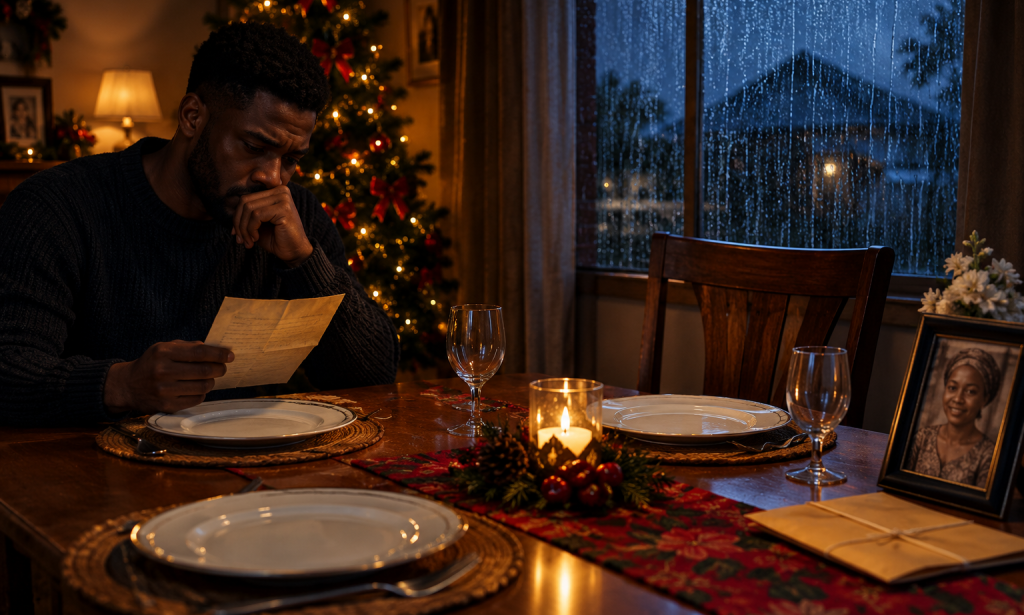
Every Christmas Eve, Daniel set three plates on the dining table.
One for himself.
One for his wife, Grace.
And one for the woman who had disappeared from his life nineteen years earlier.
His mother.
Grace never complained about the extra plate, although she had asked him the same question every December since they married.
“Daniel, what if she never comes back?”
He would always give the same answer.
“Then at least she will know there was a place for her if she ever does.”
Daniel was seven when his mother left.
He remembered the morning clearly: the sound of rain against the zinc roof, the smell of the rice she had cooked the night before, and the way she kissed his forehead before telling him to behave himself.
“I’ll be back before Christmas, my son,” she had promised.
But Christmas came and went.
Then another.
Then ten.
His father refused to discuss her. Whenever Daniel asked where she had gone, the old man would tighten his jaw and say, “Some people leave because they don’t love you enough to stay.”
Daniel grew up carrying those words like a stone in his chest.
Still, he waited.
At school, he watched other children run into their mothers’ arms after lessons. On Parents’ Day, he sat alone while teachers searched the crowd for a familiar face that never appeared.
When he graduated, he looked through the audience one last time.
When he got his first job, he imagined telling her about it.
When he married Grace, he wondered whether his mother would have liked his wife.
He never stopped wondering.
Years later, Daniel became a father himself. When his little daughter, Amara, asked why there was always an empty chair at Christmas, he knelt beside her.
“It belongs to someone I love,” he explained.
“Where is she?”
Daniel swallowed.
“I don’t know, sweetheart.”
That year, three days before Christmas, someone knocked on their door.
It was an elderly woman wearing a faded brown cardigan. Her hands trembled as she held out a yellow envelope.
“Are you Daniel?” she asked.
“Yes.”
“My name is Mrs. Okafor. I used to live next door to your family.”
Daniel remembered the name vaguely. She had moved away when he was young.
“I have something your mother asked me to keep,” she said. “I should have brought it to you years ago.”
She placed the envelope in his hands and left before he could ask another question.
Inside was a letter, its edges worn and its handwriting unmistakably familiar from the few birthday cards his mother had sent before they stopped coming.
My dearest Daniel,
If you are reading this, then you are old enough to understand something I was too afraid to explain when you were little.
I did not leave because I stopped loving you.
Daniel stopped reading.
His fingers began to shake.
The letter explained that his mother had been seriously ill when he was seven. His father had taken her away to receive treatment, telling the neighbours she had abandoned the family because he wanted to protect Daniel from the truth.
She had spent months in hospital, then years recovering far from home. She had written letters and sent messages, but many never reached Daniel. Some were returned. Others, she was told, had been delivered.
She believed her son had grown to hate her.
I wanted to come home, the letter continued. Every day, I wanted to come home. But by the time I was well enough to return, I had been told that you no longer wanted to see me.
Daniel lowered the paper.
All his life, he had believed he was the child his mother had chosen to leave.
Now he wondered whether the silence between them had been built from lies, fear, and years of missed chances.
At the bottom of the letter was one final sentence.
If you can forgive me, my son, I will be waiting at the old bus station this Christmas Eve. I will wear the brown scarf you gave me when you were six. I have never forgotten you.
Daniel looked at the date.
The letter had been written twelve years earlier.
He rushed to the old bus station anyway.
The rain fell harder as he searched the crowded entrance. He asked the attendants whether they remembered an elderly woman wearing a brown scarf. One shook his head. Another looked away apologetically.
Finally, an old ticket seller remembered her.
“She came here every Christmas for years,” he said. “She always asked whether a young man had come looking for her.”
Daniel felt his knees weaken.
“When did she stop coming?”
The man looked at him sadly.
“Three Christmases ago.”
Daniel stood in the rain, holding the letter against his chest.
For nineteen years, he had waited for his mother.
For twelve years, she had waited for him.
And somehow, between those two lonely hearts, time had quietly closed the door.
When Daniel returned home, Grace was waiting at the table. Amara had fallen asleep on the sofa.
The three plates were already set.
Daniel sat down and stared at the empty chair.
For the first time, he did not imagine his mother walking through the door.
He imagined her standing at the bus station, searching every face in the crowd, wondering whether her son had forgotten her.
A tear fell onto the old letter.
“I'm sorry, Mum,” he whispered. “I was waiting too.”
Grace reached for his hand, and neither of them spoke for a long time.
The next morning, Daniel took the extra plate from the table and placed it beside a framed photograph of his mother.
He did not remove her place from the family.
He simply stopped setting a place for someone who could no longer come home.
That Christmas, Daniel told Amara the truth about her grandmother. He promised that their family would never allow silence to do the work of honesty again.
And every year afterward, he told the same story — not to make people pity him, but to remind them that love sometimes survives even when people fail to find their way back to one another.
Because sometimes the saddest goodbyes are the ones nobody knows they are saying.


You must be logged in to post a comment.