
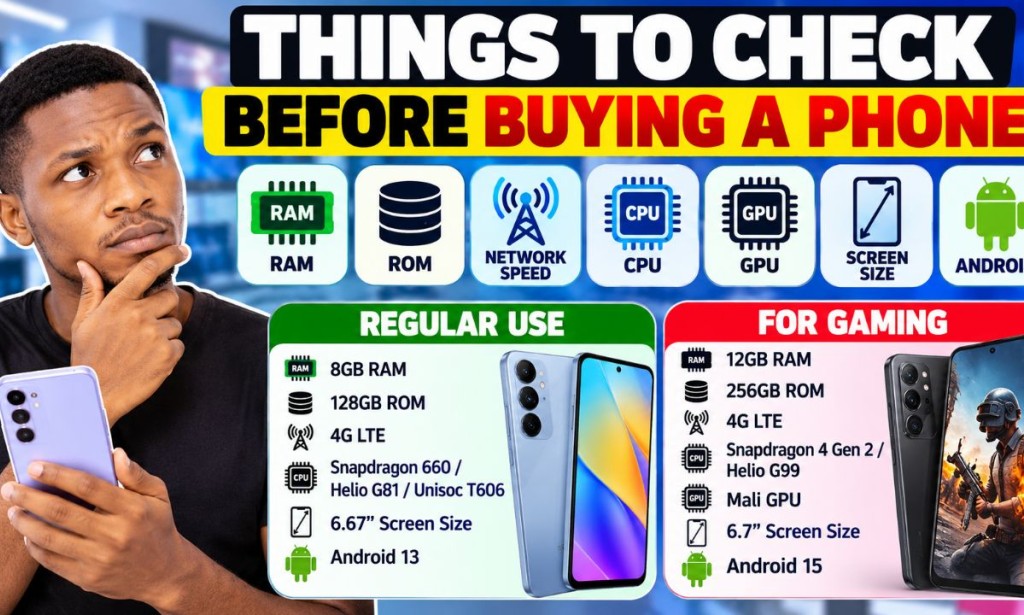
When buying a smartphone, it is important to understand the specifications before spending your money. A phone may look beautiful and have an attractive price, but its performance depends on several factors, including RAM, storage, processor, graphics, network speed, screen size, and Android version.
Whether you need a smartphone for everyday activities, social media, browsing, watching videos, or gaming, knowing these specifications will help you choose a phone that meets your needs.
In this guide, I will explain the important things to check before buying a phone and recommend specifications for regular users and mobile gamers.
1. Important Phone Specifications to Consider
Before buying a smartphone, pay attention to these seven specifications:
- RAM: Determines how well your phone handles multiple apps and multitasking.
- ROM (Internal Storage): Determines how much space you have for apps, games, photos, videos, and other files.
- Network Speed: Determines the mobile network technology your phone supports, such as 4G LTE or 5G.
- CPU (Processor): Handles the phone's general computing tasks and affects its overall performance.
- GPU: Handles graphics processing and is particularly important for gaming.
- Screen Size: Affects how comfortable the phone is for watching videos, browsing, and playing games.
- Android Version: Affects software compatibility, features, and access to security updates.
2. My Recommended Specifications for Regular Users
If you want a smartphone for everyday use, including WhatsApp, Facebook, TikTok, YouTube, web browsing, and other common activities, these are the specifications I recommend considering.
| Specification | My Recommendation | Why It Matters |
|---|---|---|
| RAM | 8GB | Provides room for multitasking and running multiple applications. |
| Internal Storage (ROM) | 128GB | Provides space for apps, photos, videos, and documents. |
| Network | 4G LTE | Supports fast mobile internet where compatible 4G coverage is available. |
| CPU (Processor) | Snapdragon 660, Helio G81, or Unisoc T606 | These processors belong to different generations and performance classes, so compare actual device performance before buying. |
| GPU | Check the graphics processor paired with the chipset | Helps determine graphics performance for videos, apps, and games. |
| Screen Size | Approximately 6.67 inches | Offers a large viewing area for browsing, reading, and watching videos. |
| Android Version | Android 13 or newer | A newer supported version can provide updated features and better long-term app compatibility. |
Who Should Consider These Specifications?
- People who use social media regularly.
- Students who need a phone for browsing and online learning.
- People who watch YouTube videos and stream content.
- Users who frequently use WhatsApp and other messaging applications.
- People who want a phone for everyday tasks without spending too much.
3. My Recommended Specifications for Mobile Gamers
If you enjoy playing mobile games, you should pay closer attention to the processor, GPU, RAM, storage, display, and battery performance.
For gaming, I recommend looking for a phone with the following specifications.
| Specification | My Recommendation | Why It Matters |
|---|---|---|
| RAM | 12GB | Provides additional memory capacity for demanding games and multitasking. |
| Internal Storage (ROM) | 256GB | Provides more room for large games, updates, recordings, and other files. |
| Network | 4G LTE | Can provide a good online gaming connection when coverage and network conditions are suitable. |
| CPU (Processor) | Snapdragon 4 Gen 2 or Helio G99 | Both are potential options for budget-conscious gaming, although performance varies by device and game. |
| GPU | Check the chipset's GPU, including Mali graphics on compatible devices | Graphics performance affects visual quality and gaming smoothness. |
| Screen Size | Approximately 6.7 inches | Provides a larger display for gaming and entertainment. |
| Android Version | Android 15 or newer | A newer supported Android version can offer updated features and compatibility. |
What Else Should Gamers Check?
RAM and processor specifications are important, but they are not the only things that determine gaming performance. Before purchasing a gaming phone, also check the following:
- GPU performance: Check how well the phone handles the games you want to play.
- Refresh rate: A 90Hz or 120Hz display can provide smoother motion in supported games.
- Battery capacity: A larger battery can help you play longer between charges.
- Cooling system: Better heat management can help maintain performance during extended gaming sessions.
- Touch response: Responsive touch controls are important for competitive games.
- Storage type: Faster storage can help reduce loading times.
- Actual gaming tests: Look for reviews showing real gameplay, frame rates, and temperature performance.
4. What Is the Difference Between RAM and ROM?
Many people confuse RAM with internal storage, but they serve different purposes.
| Feature | RAM | ROM (Internal Storage) |
|---|---|---|
| Main Purpose | Temporarily holds data used by running applications. | Stores apps, photos, videos, games, and files. |
| Example | 8GB RAM or 12GB RAM | 128GB or 256GB storage |
| When You Need More | When you want to run demanding apps and multitask comfortably. | When you install many games or save lots of photos and videos. |
My advice: Do not buy a phone based on RAM alone. A phone with 12GB RAM is not automatically faster than every phone with 8GB RAM. The processor, software optimization, memory type, and other hardware components also matter.
5. Why the CPU and GPU Matter
The CPU and GPU are two important components that influence smartphone performance.
- CPU: Handles general processing tasks, application operations, and system activities.
- GPU: Handles graphics, visual effects, and much of the rendering work required by games.
For example, if you want to play demanding games, compare the actual gaming performance of the Snapdragon 4 Gen 2 and Helio G99 rather than assuming that one specification alone tells the whole story.
Also, remember that the Snapdragon 660 is an older processor. Although it may still handle basic tasks on a suitable device, it should not automatically be treated as equivalent to newer chipsets.
6. Is 4G LTE Still Worth Buying?
Yes. A 4G LTE smartphone can still be a practical choice for everyday browsing, social media, video streaming, and online gaming, depending on network coverage and congestion.
However, if your budget allows, you can also consider a 5G smartphone. Before buying one, confirm that its supported network bands are compatible with your mobile operator and that 5G service is available where you live.
For online gaming, remember that network stability and latency are often more important than the network label alone. A stable 4G connection can sometimes perform better than a weak or congested 5G connection.
7. Why the Android Version Matters
When buying a smartphone, check the Android version it runs and whether the manufacturer still provides software and security updates.
- Check whether the phone supports the apps you need.
- Confirm whether the manufacturer provides security updates.
- Find out whether the phone is eligible for newer Android versions.
- Avoid choosing an old phone simply because it advertises a large amount of RAM or storage.
Important: Android 15 is a useful reference point for a newer device, but it is not the newest Android version available in 2026. If you are buying a phone today, consider newer supported versions where your budget allows.
8. Quick Comparison: Regular Use vs Gaming
| Specification | Regular Use | Gaming |
|---|---|---|
| RAM | 8GB | 12GB |
| Storage | 128GB | 256GB |
| Network | 4G LTE | 4G LTE or 5G, depending on budget and coverage |
| Processor | Helio G81, Unisoc T606, or a suitable alternative | Snapdragon 4 Gen 2, Helio G99, or a suitable alternative |
| Screen Size | Approximately 6.67 inches | Approximately 6.7 inches |
| Android | Android 13 or newer, preferably with ongoing support | Android 15 or newer, preferably with ongoing support |
| Additional Priority | Battery life and everyday performance | GPU, cooling, refresh rate, and sustained performance |
Conclusion
Before buying a smartphone, do not focus only on its appearance, camera, or price. Take time to check the RAM, internal storage, processor, GPU, network compatibility, screen size, and Android version.
For everyday use, I recommend considering a phone with 8GB RAM, 128GB storage, 4G LTE, and a screen around 6.67 inches. Choose a suitable processor and check its real-world performance before purchasing.
For gaming, I recommend aiming for 12GB RAM, 256GB storage, and a capable gaming processor. Also check the GPU, cooling system, battery life, and screen refresh rate to make sure the phone can handle the games you play.
Finally, remember that specifications alone do not tell the whole story. Always compare the exact phone model, read reliable reviews, and consider your budget before making a decision.
What phone are you currently using, and which phone are you planning to buy? Share your answer in the comments.


You must be logged in to post a comment.