
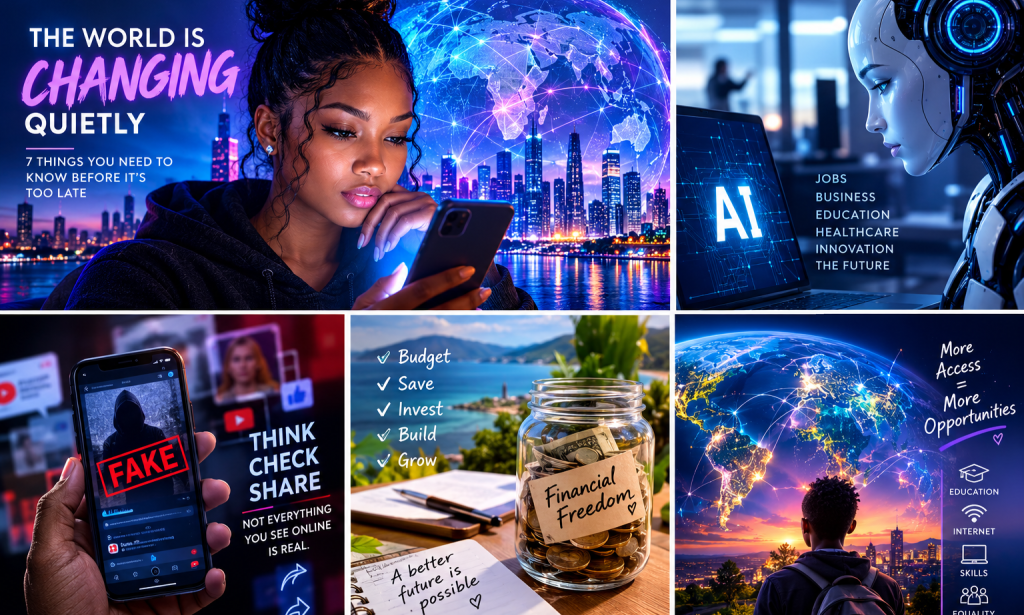
THE WORLD IS CHANGING QUIETLY: 7 THINGS YOU NEED TO KNOW BEFORE IT’S TOO LATE
The biggest changes in history don’t always arrive with a warning. Sometimes, they arrive through the phone in your hand.
Introduction: Are We Paying Attention?
Every morning, millions of people wake up, check their phones, scroll through social media, watch the news, and continue with their daily routines. We worry about bills, relationships, school, work, and finding ways to survive.
But beneath these everyday struggles, something much bigger is happening.
Technology is changing how people earn money. Artificial intelligence is transforming workplaces. Fake images and videos are making it harder to know what is real. Meanwhile, the decisions made by governments and powerful companies can affect ordinary families thousands of miles away.
The frightening part isn’t that the future is coming.
It’s that many people may be entering that future without preparing for it.
Here are seven changes worth paying attention to.
1. Your Job May Change Before You Realize It
For generations, many people believed that education, a stable job, and years of hard work would provide security. Those things still matter, but the definition of job security is changing.
Artificial intelligence can now assist with writing, customer service, research, data analysis, design, and other tasks that once required hours of human effort.
A September 2026 Pew Research Center study examined attitudes toward AI across dozens of countries and found that many people are concerned about its effects on employment.
This doesn’t mean every job will disappear. It means the tasks people perform, the skills employers value, and the way businesses operate may change significantly.
What you can do: Learn to use new digital tools, improve your communication skills, develop practical abilities, and explore more than one source of income if possible. Don’t wait until your workplace changes to start learning.
The future may reward people who can combine technology with creativity, judgment, and human understanding.
2. Seeing Is No Longer Always Believing
Imagine receiving a video of a loved one asking you for money. Their face looks real. Their voice sounds familiar. Their story seems urgent.
Would you immediately believe it?
AI-generated images, cloned voices, and manipulated videos can make false stories appear convincing. In October 2026, concerns about AI-generated evidence and deepfakes were still receiving international attention.
This creates a problem bigger than social media arguments. False content can damage reputations, spread panic, influence opinions, and help criminals deceive people.
The next time a shocking video appears on your screen, pause before sharing it.
What you can do: Check the original source, look for independent reporting, verify unusual requests through another communication channel, and never send money solely because of an alarming voice note or video.
In a world full of convincing content, careful thinking is becoming a form of protection.
3. Your Personal Information Has Value
How often do you share your birthday, location, workplace, family details, or daily activities online without thinking twice?
Small pieces of information can reveal more about a person than they realize. Scammers may use public posts and personal details to create convincing messages designed to gain trust.
Your digital identity is part of your life, even if you cannot physically touch it.
What you can do: Use strong, unique passwords, turn on two-factor authentication, limit the personal information visible on public profiles, and be suspicious of unexpected links or requests for verification codes.
Remember: a person does not need to break into your house to misuse information about you.
4. The Cost of Living Is About More Than the Price Tag
Around the world, families continue to face different combinations of housing costs, food prices, transportation expenses, and uncertain employment.
International economic developments can influence fuel, shipping, imported goods, and the cost of doing business. For countries that depend heavily on imports, including Jamaica, changes in global markets can matter to everyday households.
But there is another part of the conversation we often overlook: how prepared are we when unexpected expenses arrive?
What you can do: Track your spending, compare prices, avoid unnecessary high-interest debt where possible, build an emergency fund gradually if your circumstances allow, and invest in skills that may improve your earning opportunities.
You do not need to become wealthy overnight to become more financially aware.
Sometimes, the first step toward greater stability is understanding exactly where your money goes.
5. The Internet Is Becoming a Place Where Attention Is the Product
Have you ever opened an app for five minutes and discovered that an hour has passed?
Many digital platforms compete for attention. Emotional headlines, arguments, celebrity scandals, frightening predictions, and endless short videos can keep people scrolling long after they intended to stop.
The hidden cost is not always money. It can be time, concentration, sleep, and peace of mind.
When every spare moment is filled with somebody else’s content, when do you have time to develop your own ideas?
What you can do: Set limits on scrolling, turn off unnecessary notifications, follow sources that teach you something useful, and protect time for reading, learning, creating, and resting.
Your attention is one of your most valuable resources. Spend it intentionally.
6. The Future Will Not Affect Everyone Equally
Technology creates opportunities, but access to those opportunities is not equal.
Some people have reliable internet, modern devices, training, and the time to learn new skills. Others face unreliable connectivity, limited resources, or fewer educational opportunities.
The World Economic Forum’s 2026 Global Risks Report highlights concerns about AI-related risks, misinformation, inequality, and the unequal distribution of technological benefits.
This matters because the future is not shaped by technology alone. It is also shaped by who gets access to it, who understands it, and who is left behind.
What you can do: Share useful knowledge, help young people develop digital skills, support learning in your community, and look for legitimate ways to participate in the digital economy.
A world with more technology should also be a world with more opportunity.
7. The Most Important Skill May Be Learning How to Think
We live in a time when answers can appear in seconds. AI can generate paragraphs, summarize documents, suggest business ideas, and explain complicated topics.
But speed does not guarantee truth.
A confident answer can still be wrong. A popular post can still be misleading. A large number of views does not prove that a claim is accurate.
The ability to ask good questions, compare evidence, recognize uncertainty, and make thoughtful decisions may become increasingly important.
Before believing a claim, ask yourself:
- Who published this information?
- What evidence supports it?
- Can another trustworthy source confirm it?
- Is someone trying to make me afraid, angry, or desperate?
- What information might be missing?
These questions are simple, but they can protect you from expensive mistakes.
What Does This Mean for Young People and Families in Jamaica?
For Jamaicans, these changes are not simply distant international stories. Digital opportunities can help people learn new skills, reach customers abroad, promote businesses, and earn income online.
At the same time, online fraud, unreliable information, changing job requirements, and the cost of accessing technology deserve attention.
The goal is not to fear the future. It is to approach it with open eyes.
Young people can learn digital skills before entering the workforce. Small business owners can explore responsible uses of AI. Parents can teach children to question suspicious online content. Adults can protect their personal information and keep learning throughout their lives.
Progress becomes more useful when ordinary people are prepared to benefit from it.
Final Thoughts: Don’t Sleep Through the Changes
The world does not send everyone a personal invitation before it changes.
Sometimes, the opportunities go to those who started learning early. Sometimes, the people who avoid trouble are those who paused before believing a story or sending money. And sometimes, the most important decision is simply choosing to pay attention.
You cannot control every global event, technological breakthrough, or economic shift.
But you can control what you learn, the questions you ask, the information you share, and the steps you take to prepare.
You do not need to predict the entire future.
You need to be willing to understand the present.
Because the real question is not whether the world is changing. The real question is: What are you doing to prepare yourself?
Join the Conversation
Which of these seven changes concerns you the most: jobs and AI, online scams, the cost of living, privacy, or the spread of false information?
Share your thoughts respectfully. Someone reading your perspective may learn something that helps them prepare for tomorrow.
Sources and Further Reading
- Pew Research Center — Global attitudes toward artificial intelligence, September 2026
- World Economic Forum — Global Risks Report 2026
- International Labour Organization — Employment and Social Trends 2026
This article offers general information and practical suggestions. Global trends can affect countries and individuals differently; verify specific news and financial claims using reliable, current sources.


You must be logged in to post a comment.