

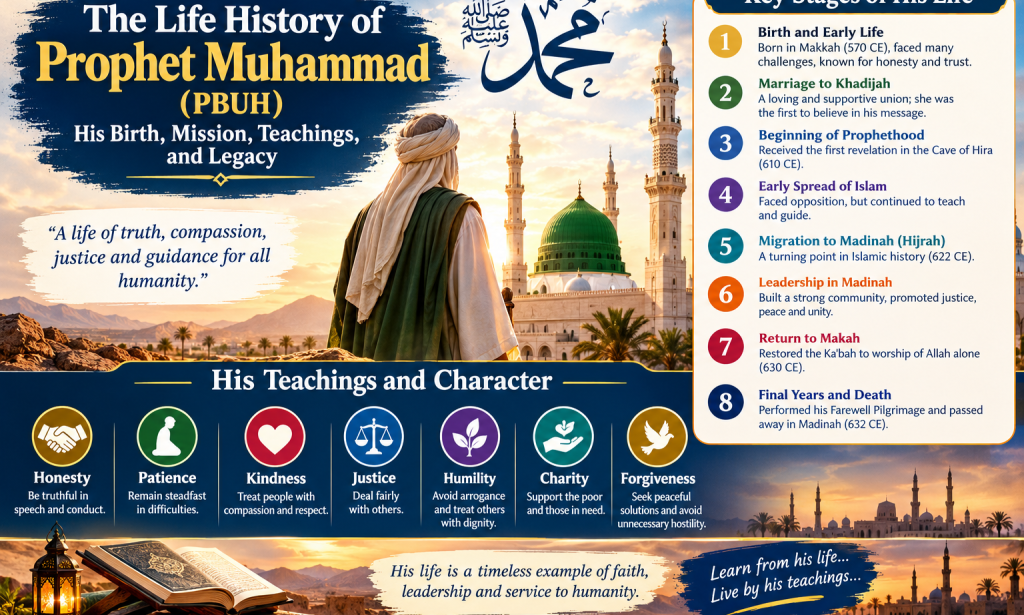
The Life History of Prophet Muhammad (PBUH): His Birth, Mission, Teachings, and Legacy
Introduction
Prophet Muhammad (peace be upon him) is the central figure of Islam and is regarded by Muslims as the final messenger of Allah. His life provides guidance on faith, patience, honesty, compassion, leadership, and justice. Muslims around the world study his life to understand his teachings and learn how to apply them in their daily lives.
His journey from Makkah to becoming the leader of the Muslim community in Madinah is one of the most significant events in Islamic history.
1. The Birth and Early Life of Prophet Muhammad
Prophet Muhammad (peace be upon him) was born in Makkah, in present-day Saudi Arabia, around 570 CE, a year traditionally known as the Year of the Elephant.
His father, Abdullah, died before his birth, and his mother, Aminah, died when he was still a young child. He was subsequently cared for by his grandfather, Abdul-Muttalib, and later by his uncle, Abu Talib.
Growing up without his parents presented many challenges, but his early experiences became part of the story Muslims remember when reflecting on patience, perseverance, and compassion for orphans.
As a young man, Muhammad became known for his honesty and trustworthiness. He earned the respect of people in Makkah through his conduct and dealings with others.
2. His Marriage to Khadijah
Prophet Muhammad later worked in trade and became known for his integrity. Khadijah bint Khuwaylid, a respected businesswoman, became aware of his good character through his work.
They married, and Khadijah became an important source of support in his life. She was the first person to believe in his prophetic mission and supported him during the early years of Islam.
Their marriage is remembered for its loyalty, mutual respect, and support.
3. The Beginning of His Prophethood
When Prophet Muhammad was approximately 40 years old, he received his first revelation while in the Cave of Hira near Makkah, according to Islamic tradition.
Muslims believe that Angel Jibril (Gabriel) delivered the revelation from Allah. The first revealed verses are associated with the opening verses of Surah Al-Alaq in the Qur'an.
This event marked the beginning of his mission to call people to worship one God, abandon idolatry, practise righteousness, and treat others with fairness and compassion.
4. The Early Spread of Islam
Prophet Muhammad began sharing the message of Islam with those close to him before preaching more openly. His early followers included Khadijah, Abu Bakr, Ali ibn Abi Talib, and Zayd ibn Harithah.
His message challenged many established religious and social practices in Makkah. As the Muslim community grew, some early Muslims experienced opposition, harassment, and persecution.
Despite these difficulties, Prophet Muhammad and his followers continued to promote their beliefs. Their experiences became important parts of Islamic history and are often studied as examples of patience and perseverance.
5. The Migration to Madinah (Hijrah)
In 622 CE, Prophet Muhammad and his followers migrated from Makkah to Yathrib, later known as Madinah. This migration is called the Hijrah.
The Hijrah was a turning point in Islamic history because it allowed the Muslim community to develop and organize itself in Madinah.
The Islamic calendar, known as the Hijri calendar, uses the Hijrah as its starting point.
In Madinah, Prophet Muhammad helped establish a community whose affairs included worship, social responsibilities, agreements between groups, and the resolution of disputes.
6. Prophet Muhammad as a Leader
In Madinah, Prophet Muhammad served as a religious guide and community leader during a period marked by political tensions and armed conflicts.
His leadership involved making agreements, resolving disputes, organizing community affairs, and guiding his followers through difficult circumstances.
Islamic tradition emphasizes his concern for justice, consultation, mercy, and the responsibilities of leadership. His life is studied by Muslims as an example of how faith should influence personal conduct and public responsibilities.
7. His Character and Teachings
Prophet Muhammad's character is central to how Muslims understand his mission. His teachings emphasized worshipping Allah, speaking truthfully, keeping promises, caring for the poor, respecting parents, and treating neighbours well.
Some important lessons associated with his life include:
- Honesty: Be truthful in speech and conduct.
- Patience: Remain steadfast when facing difficulties.
- Kindness: Treat people with compassion and respect.
- Justice: Deal fairly with others.
- Humility: Avoid arrogance and treat people with dignity.
- Charity: Support people who are poor or in need.
- Forgiveness: Seek peaceful solutions and avoid unnecessary hostility.
These principles continue to influence the religious and everyday lives of Muslims around the world.
8. The Return to Makkah
In 630 CE, Prophet Muhammad and the Muslim community entered Makkah, an event commonly known as the Conquest of Makkah.
According to Islamic historical accounts, the event was followed by the removal of idols from the Ka'bah, restoring it to worship devoted to Allah alone.
The return to Makkah is also remembered in Islamic tradition for the general amnesty extended to many former opponents. It is frequently discussed in connection with forgiveness, reconciliation, and the peaceful transformation of society, although the wider historical context included earlier conflict.
9. His Final Years and Death
During the final years of his life, Prophet Muhammad continued teaching Islam and guiding the Muslim community.
In 632 CE, he performed his Farewell Pilgrimage. His farewell address is remembered for emphasizing important responsibilities, including the protection of life and property, the fulfilment of obligations, and proper treatment of others.
Prophet Muhammad died in Madinah in 632 CE, at approximately 63 years of age according to the traditional Islamic account. He was buried in Madinah, where his burial place is associated with the Prophet's Mosque.
His death marked the end of his prophetic mission, but the Qur'an and his teachings continued to guide the Muslim community.
10. The Legacy of Prophet Muhammad
Prophet Muhammad's legacy is reflected in the lives of Muslims who follow his teachings, recite the Qur'an, observe the Five Pillars of Islam, and study his example.
His life has influenced Islamic scholarship, education, law, literature, art, and community life across many centuries and regions.
For Muslim students, learning about his history can encourage honesty, discipline, respect for teachers and parents, dedication to education, and concern for people in need.
His life is also an important subject for anyone interested in understanding the history of Islam and the development of Muslim communities.
Conclusion
The life of Prophet Muhammad (peace be upon him) is a central part of Islamic history. From his early years in Makkah to the beginning of his prophethood, the Hijrah to Madinah, and his final years, his story illustrates the development of Islam during the seventh century.
His teachings on faith, honesty, patience, justice, kindness, and responsibility remain important to Muslims today. Studying his life provides an opportunity to understand Islamic beliefs more deeply and reflect on the importance of good character in everyday life.


You must be logged in to post a comment.