

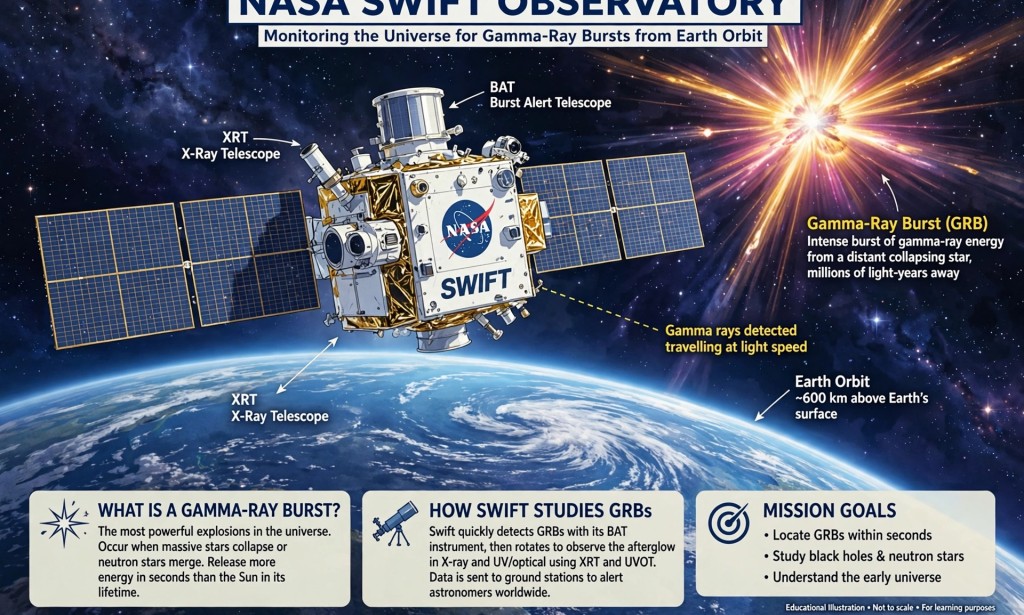
An ageing NASA telescope is barely clinging to space after a failed rescue effort left it tottering lower and lower.
NASA announced on October 23, 2026 that its Neil Gehrels Swift Observatory has ended science operations after more than 21 years in orbit. The telescope is expected to re-enter Earth's atmosphere on or around October 30, 2026, according to the U.S. Space Force.
Swift was launched on November 20, 2004, to hunt gamma-ray bursts — the biggest explosions in the universe. It was designed for just two years but lasted more than two decades, discovering over 2,000 gamma-ray bursts, 1,400 exploding stars, comets, asteroids and black holes.
The telescope's orbit dropped dangerously low to about 275km due to increased solar activity. NASA contracted Arizona-based Katalyst Space Technologies to launch a robotic spacecraft called LINK on July 3, 2026, to boost its orbit, but an attitude-control problem prevented capture.
Most of the 1.5-ton telescope is expected to burn up in the atmosphere. But pieces made of tungsten denser than lead and some mirror parts could survive re-entry. The Space Force is tracking its path, which includes swaths of Africa, Australia, India, Southeast Asia, and Central and South America.
NASA said Swift produced 12 terabytes of data and contributed to about 7,000 scientific papers. Its archive remains publicly accessible.


You must be logged in to post a comment.