
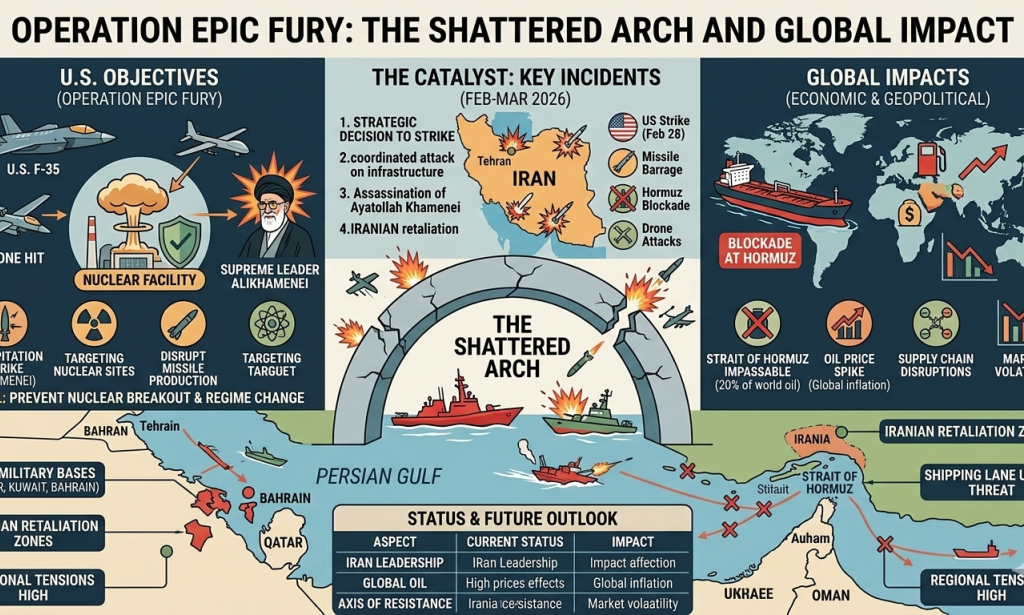
In early 2026, the long-simmering friction between the United States and Iran escalated from a "shadow war" into a direct, large-scale military conflict. This shift has fundamentally rewritten the geopolitics of the Middle East and triggered a global economic ripple effect.
The Boiling Point: Operation Epic Fury
On February 28, 2026, the United States and Israel launched a massive, coordinated military campaign—dubbed Operation Epic Fury by Washington—targeting Iran’s nuclear facilities, ballistic missile sites, and senior leadership.
The most significant development of this opening salvo was a "decapitation strike" in Tehran that killed Iran's Supreme Leader, Ayatollah Ali Khamenei. This event has plunged the Iranian government into a succession crisis while simultaneously sparking a fierce military retaliation across the region.
Why the Diplomacy Failed
The transition to war followed a year of failed "last-chance" negotiations:
The 2025 Muscat & Rome Talks: Indirect negotiations held throughout 2025 attempted to revive nuclear limits, but collapsed over U.S. demands for a permanent end to uranium enrichment and a total halt to Iran's regional proxy support.
The Nuclear "Hedging": Despite a June 2025 strike that damaged some facilities, intelligence reports in early 2026 suggested Iran was "hedging"—maintaining enough expertise and material to produce a nuclear weapon on short notice.
Domestic Turmoil: In January 2026, Iran faced its largest internal protests since the 1979 Revolution. The U.S. and Israel calculated that the regime's weakened domestic legitimacy created a strategic window to pursue "regime change" via military force.
Regional and Global Fallout
The conflict quickly expanded beyond Iran’s borders, turning the Persian Gulf into a high-intensity combat zone.
1. The Retaliation
Iran responded by launching hundreds of missiles and thousands of drones. Unlike previous skirmishes, these counter-strikes targeted:
U.S. Bases: Facilities in Bahrain, Qatar, Kuwait, and Turkey.
Energy Infrastructure: Oil and gas sites in Saudi Arabia and the UAE, leading to a surge in global energy prices.
Regional Allies: Missile strikes reached as far as Jordan and Cyprus.
2. Economic Disruption
The Strait of Hormuz, which handles roughly 20% of the world's oil supply, has become nearly impassable for commercial shipping. This has caused:
Supply Chain Crises: A massive spike in freight and fuel costs, hitting the global construction and manufacturing industries particularly hard.
Market Volatility: Global stock markets saw sharp declines as uncertainty grew over the length of the intervention.
The Current Standoff (March 2026)
As of mid-March 2026, the situation remains in a state of "violent uncertainty." While the U.S. and Israel have severely degraded Iran's air defenses and missile production, the Iranian regime's core remains entrenched.
Aspect Current Status
Iranian Leadership Succession crisis; Assembly of Experts delayed by strikes.
U.S. Strategy Sustained air campaign; avoiding large-scale ground invasion.
Oil Prices Trading at record highs due to Strait of Hormuz insecurity.
Civilian Impact Thousands of casualties; massive internal displacement in Iran.
The "Shattered Arch"
The "Axis of Resistance"—Iran’s network of proxies like Hezbollah and the Houthis—is currently fractured. However, experts warn that a prolonged power vacuum in Tehran could lead to the rise of more radical, non-state militant groups across the Middle East.


You must be logged in to post a comment.