
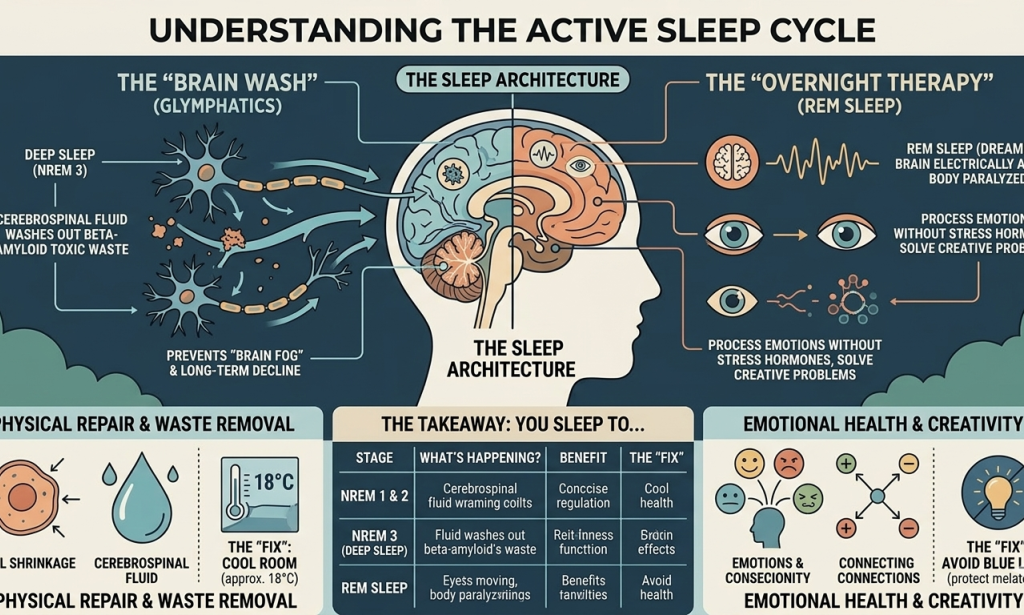
For centuries, we thought sleep was simply a "shutdown" period—the biological equivalent of turning off a computer. We now know that nothing could be further from the truth. In fact, during certain stages of the night, your brain is actually more electrically active than when you are awake and solving a math problem.
1. The Glymphatic System: The Brain’s Midnight Cleaning Crew
Imagine a busy office where nobody ever takes out the trash. Eventually, the hallways fill with junk, and the work stops. Your brain is the same. During the day, your neurons are firing away, creating a metabolic byproduct called Beta-amyloid (the same protein linked to Alzheimer’s).
When you fall into deep sleep, your brain cells literally shrink by about 60%. This creates space between the cells, allowing cerebrospinal fluid to rush in and "power wash" the metabolic waste away.
Key Takeaway: You don't sleep to rest; you sleep to clean. Without this wash, your brain remains "clogged," leading to that familiar "brain fog" the next morning.
2. REM: The Virtual Reality Simulator
About 90 minutes into sleep, you enter REM (Rapid Eye Movement). This is where things get weird. Your body becomes paralyzed (to stop you from acting out your dreams), but your brain activity spikes.
Emotional First Aid: REM sleep is the only time our brain is completely devoid of the stress molecule noradrenaline. This allows us to reprocess upsetting memories without the "sting" of the actual stress, acting as a form of overnight therapy.
Creative Problem Solving: During REM, your brain makes connections between distant ideas that your logical "awake" brain would never consider. This is why you often wake up with the solution to a problem you couldn't solve the day before.
The Sleep Architecture: A Quick Guide
Your night is divided into 90-minute cycles, shifting between deep "cleaning" sleep and active "dreaming" sleep.
Stage What’s Happening? Main Benefit
NREM 1 & 2 Light sleep; heart rate drops. Transition and motor memory.
NREM 3 Deep, slow-wave sleep. Physical repair & brain cleaning.
REM High brain activity; dreaming. Emotional
How to Master the "Clean"
If you want to optimize this process, you have to respect the Circadian Rhythm. Your brain's "cleaning crew" is on a timer controlled by light.
The Temperature Drop: Your body needs to drop its core temperature by about 1°C to initiate deep sleep. This is why a cool room (around 18°C) is better than a hot one.
The Blue Light Myth: It’s not just about eye strain. Blue light from phones suppresses melatonin, the hormone that tells the "cleaning crew" to start their shift.


You must be logged in to post a comment.