

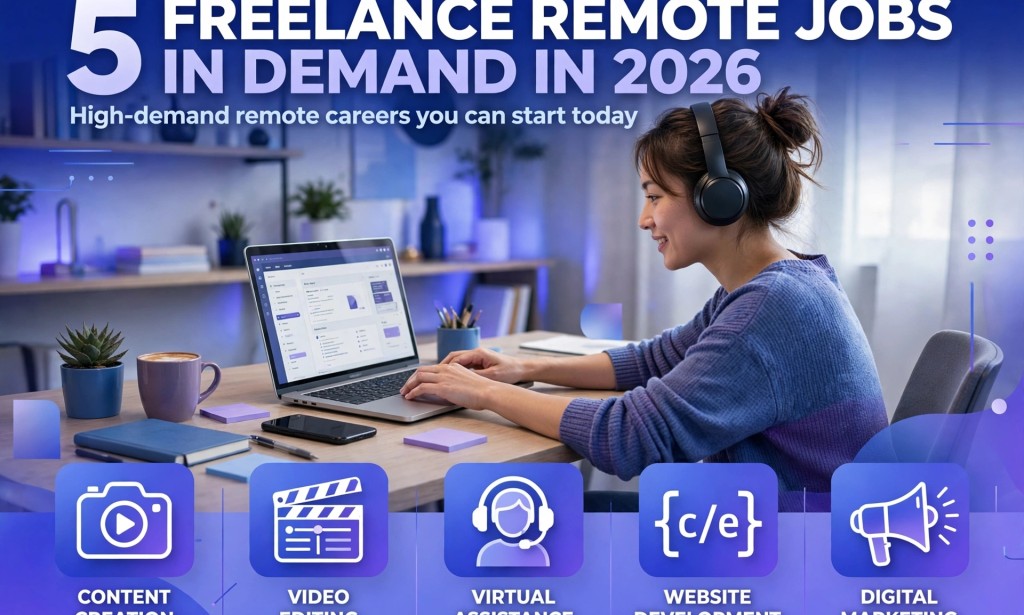
5 Freelance Remote Jobs That Are Exploding In Demand In 2026
The internet has changed how people work, allowing talented individuals to offer services to businesses and clients without travelling to a physical office. In 2026, freelancing continues to provide opportunities for people who want greater flexibility, independent work, and the ability to develop skills from home.
Businesses increasingly need help with digital content, customer communication, website development, and online marketing. Instead of hiring full-time employees for every task, some companies work with freelancers who have the specific skills needed to complete individual projects.
According to Upwork, demand for skills explicitly involving artificial intelligence grew by 109% year over year in its 2026 skills report. Established services such as virtual assistance, graphic design, data analytics, and web development also remained important on its marketplace. These findings suggest that combining practical skills with newer technologies can create opportunities for freelancers.
Here are five freelance remote jobs worth exploring in 2026.
1. AI-Assisted Content Creation
Businesses need content to communicate with customers, promote products, and build an online presence. This includes blog articles, social media posts, newsletters, product descriptions, and website copy.
AI tools can help content creators brainstorm ideas, organise information, and develop initial drafts. However, businesses still need people who can check accuracy, understand audiences, improve writing, and produce original material that serves a clear purpose.
As an AI-assisted content creator, you might help a small business plan a month's worth of social media posts or prepare informative articles for its website.
Skills to develop:
- Clear writing and editing.
- Research and fact-checking.
- Search engine optimisation fundamentals.
- AI prompting and responsible tool use.
- Understanding different audiences and writing styles.
You can begin by creating sample articles, product descriptions, and social media campaigns for fictional businesses. Organise your strongest work into a portfolio that demonstrates your writing ability.
Potential clients include online publications, small businesses, marketing agencies, and content creators.
The key is to offer more than automatically generated text. Your value comes from making content accurate, useful, engaging, and appropriate for its intended audience.
2. Short-Form Video Editing
Short videos have become an important format for businesses, educators, influencers, and online creators.
Video editors help transform raw recordings into polished content by removing unnecessary sections, adding subtitles, improving audio, incorporating graphics, and arranging scenes into a clear story.
Some clients need videos for product promotions, while others want educational clips, interviews, tutorials, or entertaining social media content.
You can start learning video editing with a mobile phone and a suitable editing application. A computer can provide additional options as your projects become more complex, but it is not always necessary for beginner-level work.
Skills to develop:
- Cutting and arranging clips.
- Adding readable subtitles.
- Improving audio quality.
- Using transitions appropriately.
- Understanding pacing and storytelling.
Start by creating several original sample videos. Practise turning a long recording into a concise clip that communicates one clear message.
As your abilities improve, build a portfolio showing different editing styles. This helps prospective clients understand what you can deliver.
AI-assisted video tools are also becoming more relevant. Upwork's 2026 research reported a 329% year-over-year increase in demand for AI video generation and editing skills on its marketplace. This is a platform-specific finding rather than a guarantee of demand everywhere, but it highlights an area worth investigating.
3. Virtual Assistance
Virtual assistants help individuals and businesses manage administrative tasks remotely.
Their responsibilities can include organising schedules, maintaining spreadsheets, managing emails, researching information, preparing documents, and coordinating appointments.
Some virtual assistants specialise in supporting online stores, content creators, or business owners. Others provide general administrative support.
This field can be attractive to beginners because you can start by developing organisation and communication skills before specialising in a particular industry.
Skills to develop:
- Professional written communication.
- Time management and organisation.
- Spreadsheet and document skills.
- Online research.
- Calendar and task management.
- Familiarity with digital collaboration tools.
You can practise by creating a sample weekly schedule, organising a fictional business's customer enquiries, or building a spreadsheet that tracks orders and deadlines.
These projects demonstrate your ability to organise information and complete tasks accurately.
Reliability is especially important in this role. Clients need someone who follows instructions, communicates clearly, respects confidentiality, and completes agreed tasks on time.
Virtual assistance can also provide a foundation for specialising in project coordination, e-commerce support, or other administrative services as your experience grows.
4. Website Design and Development
Businesses need websites to display their services, sell products, publish information, and communicate with customers.
Website designers focus on how a site looks and feels, while developers build and maintain its functionality. Depending on your skills, you might eventually offer both services.
Beginners can explore website builders and content management systems before learning more advanced programming techniques.
Skills to develop:
- Website layout and navigation.
- Mobile-friendly design.
- Typography and visual hierarchy.
- Basic search engine optimisation.
- Website testing and troubleshooting.
- HTML and CSS if you choose a coding-focused path.
Begin by creating practice websites for fictional businesses, such as a restaurant, clothing shop, or personal portfolio.
Pay attention to whether the site works well on mobile devices, loads appropriately, and makes important information easy to find.
You can then document your projects with screenshots or working demonstrations.
Website development may require more time to learn than some other freelance services, especially if you want to build complex applications. However, starting with smaller websites allows you to develop your abilities gradually.
Upwork's 2026 research identifies web design, web development, and related technical skills among continuing areas of freelance demand.
5. Digital Marketing and Social Media Management
Digital marketing helps businesses reach audiences, communicate their value, and attract customers online.
Freelancers in this field might plan social media calendars, write promotional captions, research audiences, improve website visibility, or analyse the performance of marketing campaigns.
Social media management is one possible entry point. You can begin by learning how to create consistent content and understand what makes posts relevant to a particular audience.
Skills to develop:
- Social media content planning.
- Basic marketing principles.
- Audience research.
- Search engine optimisation fundamentals.
- Reading engagement and traffic metrics.
- Writing clear promotional messages.
Create a sample campaign for a fictional business. Include a content calendar, several example posts, and an explanation of the audience you are trying to reach.
You can also practise reviewing publicly available information to understand how businesses communicate online.
As your experience grows, consider specialising in a particular area, such as content strategy, email marketing, or search engine optimisation.
Specialisation can help you demonstrate a clearer value to prospective clients than simply describing yourself as someone who does everything.
How to Start Freelancing Successfully in 2026
Choosing a promising field is only the first step. Building a sustainable freelance career requires practice, patience, and the ability to demonstrate your skills.
Choose one service first. Trying to master five different professions simultaneously can make progress difficult. Start with the field that matches your interests, equipment, and available learning time.
Build a portfolio. Create original sample projects that demonstrate what you can do. You do not need to wait for a paying client before practising, but always label fictional projects clearly.
Learn to communicate professionally. Clients value freelancers who understand instructions, ask sensible questions, meet deadlines, and provide updates when necessary.
Research the market. Review job descriptions and client requests to understand which skills are required. Look for repeated requirements and use them to guide your learning.
Start with realistic expectations. Your first project may take time to find, and your initial work may require improvement. Earnings depend on skill, competition, client demand, experience, and the quality of your service.
Be cautious of supposed employers who demand payment for a job offer or promise guaranteed earnings without meaningful work.
Finally, remember that freelance marketplaces and individual clients may have age, identity, payment, or location requirements. Read their rules and involve a trusted adult where appropriate rather than attempting to bypass restrictions.
Final Thoughts
Freelancing offers several ways to turn practical digital skills into services that businesses may need.
AI-assisted content creation, short-form video editing, virtual assistance, website development, and digital marketing are five fields worth exploring in 2026.
You do not need to learn everything at once. Choose one skill, practise consistently, create examples of your work, and improve based on feedback.
The goal is not simply to find a job that is popular today. It is to develop a useful ability that solves real problems and can continue to improve as technology and client needs change.
Which of these five freelance jobs interests you most, and which one would you like to learn first?
If you found this article helpful, please like it, leave a comment, share it with someone exploring remote work, and follow my profile for more job opportunities and educational content. You can also donate to support my writing and help me publish more useful articles.
Disclaimer: This article is for educational purposes. Freelance demand varies by market, and learning a skill does not guarantee employment or a particular income.


You must be logged in to post a comment.