
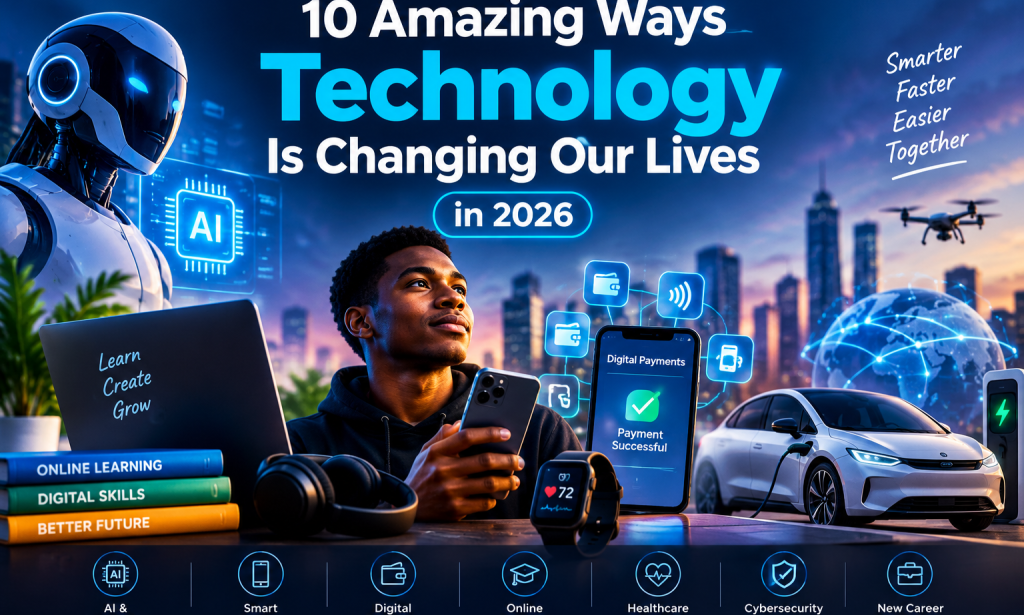
10 Amazing Ways Technology Is Changing Our Lives in 2026
Imagine waking up in the morning, asking your phone about the weather, using artificial intelligence to organize your day, attending a virtual meeting, and paying for lunch without touching cash. A few decades ago, some of these experiences sounded like science fiction. Today, they are becoming part of everyday life.
Technology is changing how we communicate, learn, work, travel, and entertain ourselves. From artificial intelligence to smart devices, new innovations are creating opportunities while introducing challenges that society must learn to manage.
But how exactly is technology transforming our lives in 2026? Here are ten fascinating examples worth exploring.
1. Artificial Intelligence Is Becoming an Everyday Assistant
Artificial intelligence, commonly known as AI, is one of the most influential technologies of our time.
AI tools can help people brainstorm ideas, summarize information, translate languages, write computer code, and organize their work. Students can use them to understand difficult concepts, while businesses can use them to handle repetitive tasks.
However, AI is not perfect. It can produce incorrect information, so important facts should always be checked.
The most effective approach is to use AI as an assistant rather than blindly trusting everything it produces.
2. Smartphones Are Becoming More Powerful
Smartphones have developed far beyond their original purpose of making calls and sending text messages.
Modern phones can take high-quality photographs, edit videos, run sophisticated applications, support online learning, and provide access to digital financial services.
For content creators, a smartphone can serve as a portable studio. With the right applications, someone can write articles, design graphics, edit videos, and publish content without owning an expensive computer.
This development is making digital creativity more accessible to people around the world.
3. Digital Payments Are Changing How People Handle Money
Digital payments have made it easier to send and receive money without physically visiting a bank.
Mobile banking applications, digital wallets, and contactless payment systems allow people to complete many transactions using their phones.
In countries such as Nigeria, digital financial services are particularly relevant to people who want convenient ways to manage everyday transactions.
Nevertheless, convenience comes with responsibility. Users should protect their passwords, enable available security features, and never disclose their banking PINs or wallet recovery phrases.
4. Online Learning Is Opening New Opportunities
Education is no longer limited to traditional classrooms.
Students can access online courses, educational videos, digital libraries, and interactive learning platforms from different parts of the world.
Someone interested in graphic design, programming, writing, or digital marketing can begin learning these skills online, sometimes without paying for a course.
Online education also allows learners to study at their own pace.
Although internet access and reliable devices remain challenges in some communities, digital learning continues to create new opportunities for people seeking knowledge.
5. Technology Is Transforming Healthcare
Technology is helping healthcare professionals improve how they monitor patients, manage medical information, and identify certain health conditions.
Digital health records can make information easier for authorized healthcare workers to access. Telemedicine can also allow patients to consult healthcare professionals remotely where these services are available.
Artificial intelligence is being researched and used in areas such as medical imaging and clinical decision support.
However, technology does not replace qualified healthcare professionals. Medical decisions require appropriate expertise, and personal health information must be handled carefully.
6. Social Media Has Changed How the World Communicates
People can now share ideas, photographs, videos, and breaking developments with audiences across the world in seconds.
Platforms such as TikTok, Instagram, YouTube, and Facebook have created opportunities for entertainers, educators, journalists, and independent content creators.
Someone with a smartphone and an internet connection can potentially build an international audience.
However, social media also spreads misinformation and can expose users to scams. Before sharing a sensational story, it is important to verify its accuracy.
The ability to communicate instantly is powerful, but responsible communication matters just as much.
7. Smart Homes Are Making Everyday Tasks Easier
Smart-home technology allows certain household devices to communicate with one another or be controlled remotely.
Depending on the equipment, people can use their phones to control lighting, adjust thermostats, monitor security cameras, or manage other connected appliances.
Some systems can also automate repetitive tasks, helping households save time.
However, connected devices can introduce privacy and security risks. Users should install updates, choose strong passwords, and purchase products from reputable manufacturers.
Smart homes demonstrate how technology can make ordinary activities more convenient.
8. Electric Vehicles Are Changing Transportation
Electric vehicles use electric motors rather than relying exclusively on conventional petrol or diesel engines.
They can produce no exhaust emissions while driving, although their overall environmental impact depends on factors such as electricity generation, battery production, and manufacturing.
Improvements in batteries and charging infrastructure are helping make electric transportation more practical in many locations.
Nevertheless, charging access, purchase prices, and electricity reliability remain important challenges in different parts of the world.
As technology develops, electric vehicles may play an increasingly important role in transportation.
9. Cybersecurity Is More Important Than Ever
As people conduct more activities online, protecting personal information has become increasingly important.
Cybercriminals may attempt to steal passwords, impersonate trusted organizations, distribute malicious software, or trick people into sending money.
Fortunately, users can take practical steps to improve their security.
These include using unique passwords, enabling two-factor authentication, updating devices, and avoiding suspicious links.
People using cryptocurrency wallets should also protect their recovery phrases and never share them with anyone claiming they need them to verify a payment.
Digital security is no longer just a concern for large companies. It matters to everyone who uses the internet.
10. Technology Is Creating New Career Opportunities
Technology is changing the skills employers and customers need.
Fields such as software development, cybersecurity, digital design, data analysis, and artificial intelligence offer different career paths.
Meanwhile, content creation, video editing, online writing, and digital marketing allow people to develop skills that can be used by businesses and individual clients.
However, learning a skill does not guarantee employment or income. Success often requires practice, patience, a strong portfolio, and an understanding of what customers actually need.
For young people especially, developing useful digital skills can be a valuable investment in their future.
Conclusion: The Future Belongs to Those Who Learn
Technology is transforming nearly every part of modern life, from communication and education to transportation and healthcare.
These changes bring exciting possibilities, but they also demand responsibility. Privacy, cybersecurity, misinformation, and unequal access to technology remain important issues.
The best way to benefit from technological progress is to stay curious, keep learning, verify information, and use digital tools wisely.
Technology is not simply changing the world around us. It is changing the opportunities available to people who know how to use it.
The big question is this: Which technology will have the greatest impact on our lives over the next five years?


You must be logged in to post a comment.