
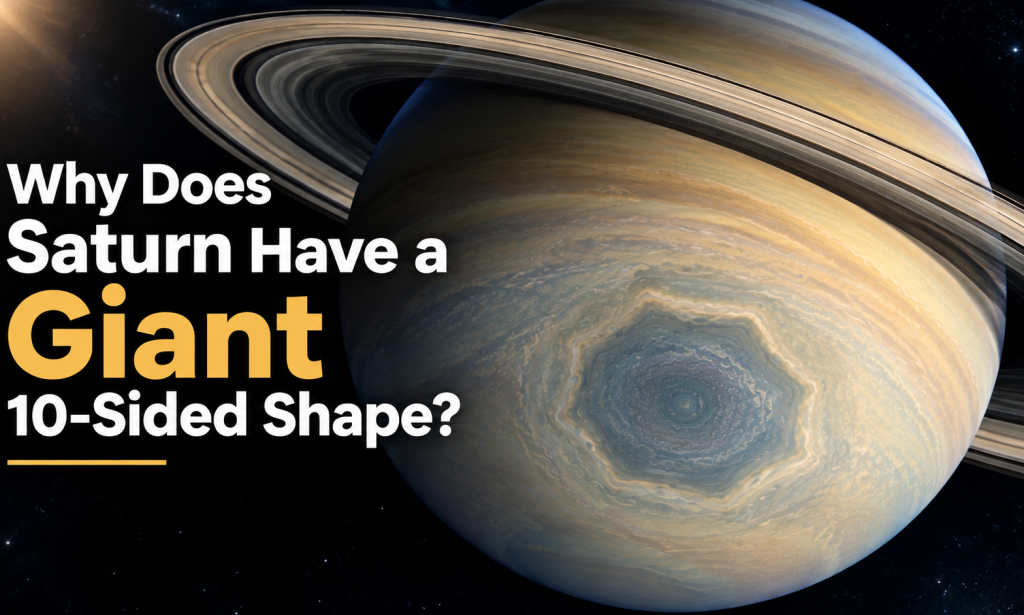
Saturn is one of the most recognizable planets in our solar system, famous for its brilliant rings. But recent observations have revealed something much stranger: a giant, evolving 10-sided atmospheric wave surrounding Saturn’s south pole.
The discovery was made using NASA’s Hubble Space Telescope and reported by NASA and the European Space Agency on September 2, 2026. Scientists say the feature is the first large, regular-sided jet pattern observed in Saturn’s southern hemisphere.
It Is Not a 10-Sided Planet
The first thing to understand is that Saturn itself is not shaped like a decagon.
The 10-sided appearance comes from a wave in Saturn’s atmosphere. The feature is embedded within one of the planet’s powerful jet streams and is centered around about 63 degrees south latitude. Hubble observations at different wavelengths show the structure at different atmospheric altitudes.
Scientists have found evidence that the feature was already present as early as 2023, but it became increasingly distinct over the following years.
Saturn Already Has a Famous Six-Sided Pattern
This discovery is particularly interesting because Saturn is already famous for another unusual geometric atmospheric feature.
At its north pole, the planet has a huge six-sided jet stream known as the Saturnian hexagon. It has been observed for decades and is one of the most unusual weather patterns known in the solar system.
But until now, scientists had not seen a comparable large, regular-sided pattern in Saturn’s southern hemisphere. The newly observed decagon may therefore give researchers an opportunity to study a very different kind of atmospheric wave.
How Can an Atmosphere Form a Shape Like This?
Saturn is a rapidly rotating gas giant with powerful atmospheric winds and jet streams.
According to the research, the newly observed decagon is associated with one of these strong jet streams. Atmospheric waves can interact with fast-moving flows of gas, producing organized structures instead of completely random patterns.
However, scientists are still studying exactly how this southern decagon forms and why it has developed into such a regular shape. The researchers describe it as an evolving atmospheric phenomenon, meaning its future behavior could provide important clues.
Why Was It Not Seen Earlier?
That is another interesting part of the discovery.
NASA’s Hubble has been monitoring the outer planets through its Outer Planet Atmospheres Legacy (OPAL) program for more than a decade. By comparing observations taken over several years, researchers were able to identify subtle signs of the southern pattern before it became clearly defined.
Earlier observations from NASA’s Cassini mission, which studied Saturn between 2004 and 2017, did not reveal a similarly obvious long-lasting southern counterpart to the northern hexagon.
This does not mean the feature suddenly appeared from nowhere. Instead, scientists now have evidence that it developed gradually and became easier to detect over time.
What Could Scientists Learn From It?
The decagon gives researchers a rare chance to watch a large atmospheric structure change.
By continuing to observe Saturn, scientists can study how the wave evolves, how it behaves at different atmospheric levels, and how it interacts with Saturn’s jet streams. That could improve our understanding of atmospheric dynamics not only on Saturn but also on other planets with powerful atmospheres.
The research has been published in Science Advances under the title “A decagon wave around Saturn’s south pole.”
A New Saturn Mystery
Saturn has already amazed scientists with its rings and its strange northern hexagon. Now, observations from Hubble have added another mystery: a giant 10-sided atmospheric wave developing around its south pole.
It may look almost too geometric to be natural, but scientists believe it is the result of complex atmospheric processes on the gas giant.
And the most interesting part may be that researchers are watching it change in real time.
What will the decagon look like several years from now? Scientists will have to keep watching Saturn to find out.

You must be logged in to post a comment.