

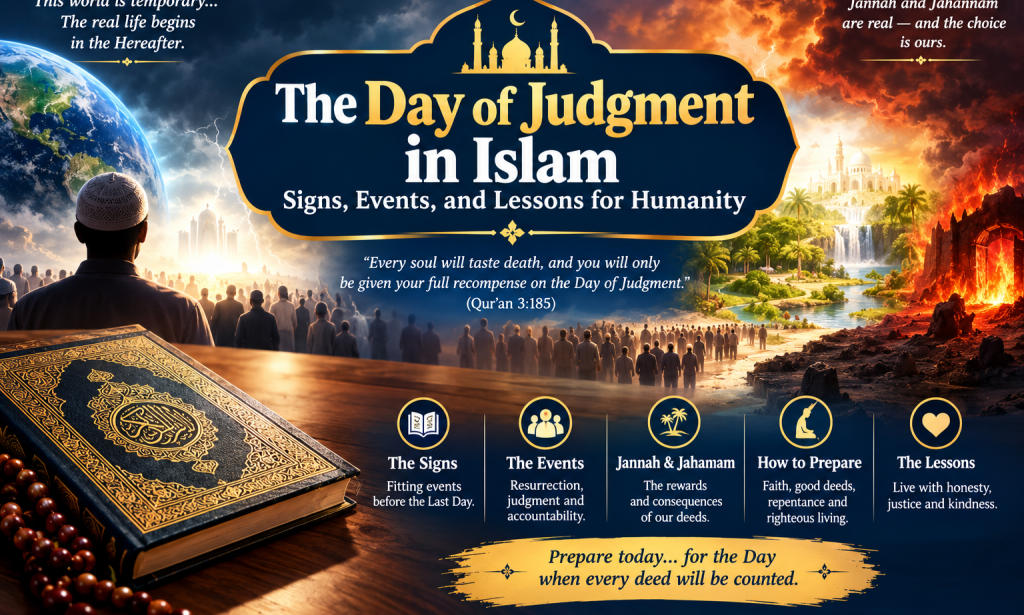
The Day of Judgment in Islam: Signs, Events, and Lessons for Humanity
Introduction
The Day of Judgment, also known as Yawm al-Qiyamah, is one of the fundamental beliefs in Islam. Muslims believe that life in this world is temporary and that every human being will eventually be resurrected and held accountable by Allah for their deeds.
Belief in the Day of Judgment is an important part of Islamic faith because it reminds people that their actions have consequences and encourages them to live responsibly, worship Allah, and treat others with justice and kindness.
The Qur'an discusses the Hereafter in many chapters, reminding humanity that worldly life is not the final destination.
1. What Is the Day of Judgment?
The Day of Judgment is the day when Allah will resurrect humanity and judge everyone according to their deeds.
Muslims believe that every individual will stand before Allah and be accountable for their beliefs, actions, intentions, and responsibilities.
It is also called Yawm al-Hisab, meaning the Day of Reckoning.
The Qur'an teaches that Allah is perfectly just and that nobody will be treated unfairly.
2. Why Do Muslims Believe in the Day of Judgment?
Belief in the Hereafter is one of the six articles of faith in Islam.
It reminds Muslims that:
- Life in this world is temporary.
- Every individual is responsible for their actions.
- Justice will ultimately be established by Allah.
- Good deeds and sincere worship are important.
- People should seek forgiveness and avoid wrongdoing.
This belief encourages Muslims to make positive choices and remember their responsibilities.
3. The Major Signs of the Day of Judgment
Islamic teachings mention signs that will occur before the Day of Judgment.
Some signs are described in authentic Hadith, including:
1. The appearance of the Dajjal.
2. The return of Prophet Isa (Jesus), peace be upon him.
3. The emergence of Ya'juj and Ma'juj.
4. The rising of the sun from the west.
5. The appearance of the Beast of the Earth.
Islamic scholars explain these signs using the Qur'an and authentic Sunnah.
Muslims are encouraged to focus on strengthening their faith rather than making unsupported predictions about when the Last Day will occur.
4. What Will Happen on the Day of Judgment?
Islam teaches several important events associated with the Hereafter.
Resurrection
Allah will resurrect human beings after death. Everyone will be brought back for the final judgment.
Gathering of Humanity
All people will be gathered before Allah. Nobody will be able to escape His knowledge or authority.
Presentation of Deeds
People will be shown their deeds and held accountable for their actions.
The Weighing of Deeds
Islamic teachings describe the weighing of people's deeds as part of the judgment.
Accountability
Every individual will be judged with perfect justice by Allah, who knows everything about human intentions and actions.
5. Jannah and Jahannam
Islam teaches that Jannah (Paradise) and Jahannam (Hell) are realities of the Hereafter.
Jannah: Paradise is the everlasting reward Allah has prepared for the righteous believers. It is described in the Qur'an as a place of peace, blessings, and happiness.
Jahannam: Hell is described as a place of punishment for those who deserve it according to Allah's perfect justice.
These teachings remind Muslims to seek Allah's mercy, obey His guidance, and avoid wrongdoing.
6. How Can Muslims Prepare for the Day of Judgment?
Muslims are encouraged to prepare through faith and righteous actions.
Some important practices include:
1. Worship Allah sincerely.
2. Observe the five daily prayers.
3. Read and understand the Qur'an.
4. Seek forgiveness for mistakes.
5. Respect parents and family members.
6. Give charity and help people in need.
7. Avoid dishonesty, injustice, and harmful behaviour.
8. Fulfil promises and responsibilities.
9. Treat neighbours and other people fairly.
10. Maintain good character.
Preparation is not simply about knowing the signs of the Last Day; it is about living according to Islamic guidance every day.
7. The Importance of Repentance
Islam teaches that Allah is Most Merciful and encourages people to repent sincerely when they make mistakes.
Repentance involves acknowledging wrongdoing, feeling genuine regret, stopping the wrong action, and resolving not to return to it.
When another person's rights have been violated, the individual should also make an effort to restore those rights.
Muslims should never lose hope in Allah's mercy.
8. Lessons the Day of Judgment Teaches Humanity
Belief in the Day of Judgment provides several important lessons:
- Responsibility: Every person should take responsibility for their actions.
- Honesty: People should be truthful even when nobody is watching.
- Justice: Nobody should deliberately violate another person's rights.
- Kindness: Helping others and showing compassion are valuable deeds.
- Humility: Wealth, fame, and social position are temporary.
- Faith: Muslims should remain committed to worshipping Allah.
- Repentance: People should correct their mistakes and seek forgiveness.
Conclusion
The Day of Judgment is a central belief in Islam. It reminds Muslims that this worldly life is temporary and that everyone will eventually return to Allah.
Through belief in resurrection, accountability, Jannah, and Jahannam, Islam encourages people to live with sincerity, justice, patience, and good character.
Rather than becoming distracted by predictions about the Last Day, Muslims should focus on strengthening their faith, performing good deeds, seeking forgiveness, and fulfilling their responsibilities.
Final Reminder: Nobody knows the exact time of the Day of Judgment except Allah. Therefore, the best preparation is to live a life of faith, righteousness, and good character.


You must be logged in to post a comment.