
📌 Table of Contents
- Introduction
- What is Senior Secondary School in Nigeria?
- Overview of the 2025 NERDC Curriculum Update
- Structure of SS1–SSS3 Subjects
- Core Compulsory Subjects for All Students
- Trade / Entrepreneurship Subject Requirement
- Science Stream Subjects
- Arts (Humanities) Stream Subjects
- Commercial (Business) Stream Subjects
- Subject Combination System Explained
- WAEC and NECO Subject Requirement
- Importance of the New Curriculum
- How to Choose the Right Subject Combination
- Common Mistakes Students Make
- FAQs
- Conclusion
1. Introduction
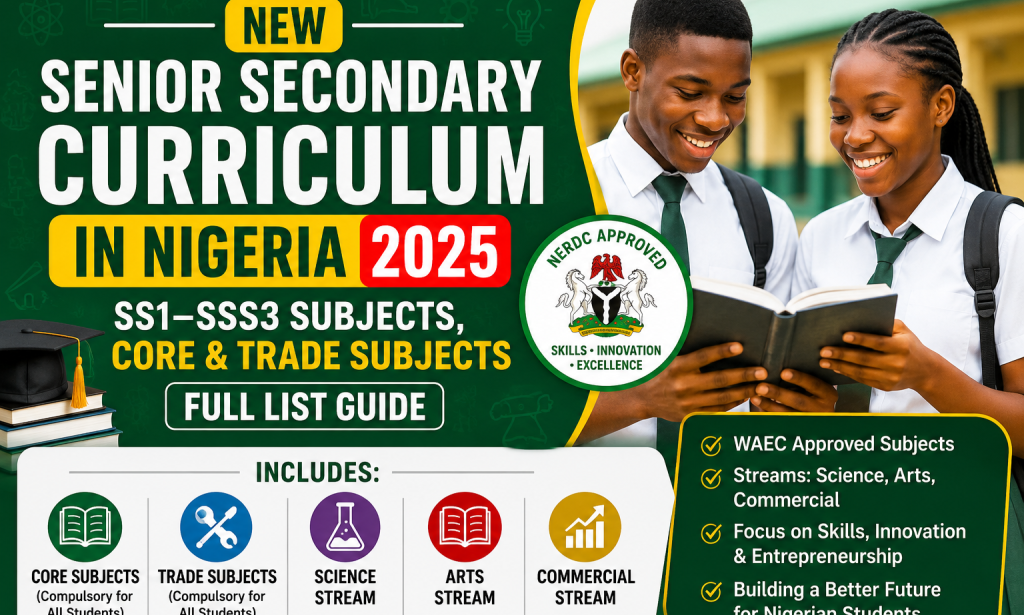
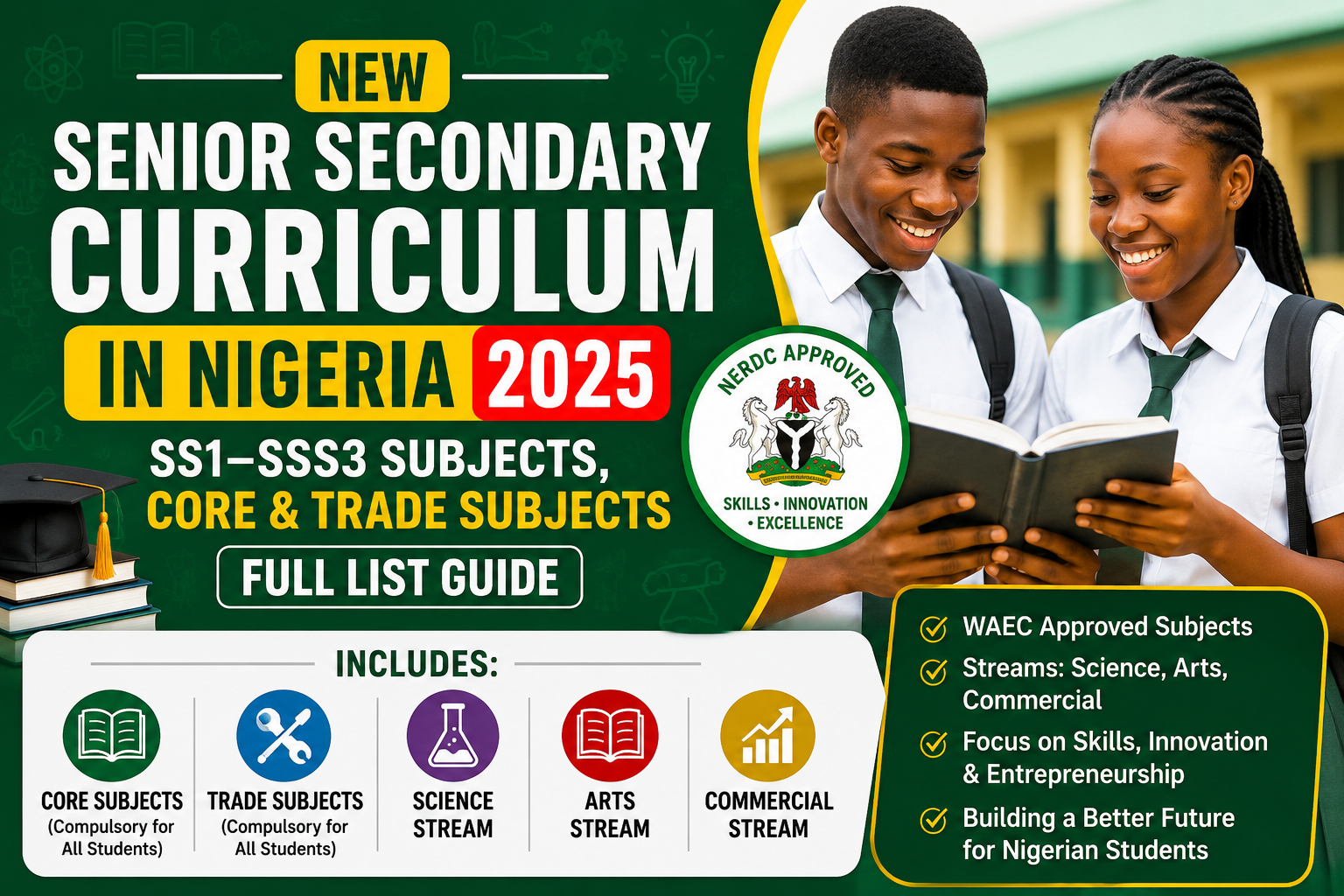
In 2025, Nigeria introduced a revised Senior Secondary School Curriculum developed by the Nigerian Educational Research and Development Council (NERDC) in collaboration with the Federal Ministry of Education and examination bodies such as WAEC and NECO.
The aim of this updated curriculum is to shift Nigerian education from theory-based learning to a skills-based and career-focused system. It ensures that students not only gain academic knowledge but also acquire practical and entrepreneurial skills before leaving secondary school.
This new structure applies to SS1, SS2, and SS3 students across Nigeria.
2. What is Senior Secondary School in Nigeria?
Senior Secondary School (SSS) is the final stage of secondary education in Nigeria. It covers:
- SS1 (Senior Secondary 1)
- SS2 (Senior Secondary 2)
- SS3 (Senior Secondary 3)
At this level, students begin to specialize in subjects based on their future careers, whether in Science, Arts, or Commercial fields.
It also prepares students for:
- WAEC (West African Examination Council)
- NECO (National Examination Council)
- JAMB/University admission
3. Overview of the 2025 NERDC Curriculum Update
The updated curriculum introduced in 2025 emphasizes:
- Reduction and restructuring of overloaded subjects
- Introduction of Trade / Vocational subjects
- Strong focus on ICT and digital literacy
- Clear subject specialization into streams
- Competency-based learning instead of memorization
The goal is to produce students who are:
- Employable
- Skilled
- Entrepreneurial
- Academically sound
4. Structure of SS1–SSS3 Subjects
The senior secondary curriculum is divided into:
✔ 1. Core Compulsory Subjects
✔ 2. Trade / Entrepreneurship Subject
✔ 3. Stream-Based Subjects
- Science
- Arts (Humanities)
- Commercial
Students must choose subjects based on their career path.
5. Core Compulsory Subjects (All Students)
Every SS1–SSS3 student must take the following:
📘 English Language
- Essay writing
- Comprehension
- Grammar
- Summary writing
📗 General Mathematics
- Algebra
- Statistics
- Geometry
- Trigonometry basics
🌍 Civic Education / Citizenship Studies
- National values
- Human rights
- Democracy
- Citizenship responsibilities
💻 Digital Technologies / ICT
- Computer fundamentals
- Internet use
- Digital literacy
- Basic programming awareness
6. ⭐ Trade / Entrepreneurship Subject (MANDATORY)
A key part of the new curriculum is that every student must choose ONE trade subject and continue it throughout senior secondary school.
🔧 Available Trade Subjects:
- Fashion Design & Garment Making
- Solar Installation & Maintenance
- Computer Hardware & GSM Repairs
- Beauty and Cosmetology
- Livestock Farming
- Horticulture & Crop Production
📌 Importance:
- Builds practical skills
- Encourages self-employment
- Reduces unemployment
- Promotes entrepreneurship
7. 🔬 Science Stream Subjects
Science students focus on technical and natural sciences:
- Physics
- Chemistry
- Biology
- Agricultural Science
- Further Mathematics (optional but important)
- Technical Drawing
- Geography (in some schools)
Career paths:
- Medicine
- Engineering
- Nursing
- ICT and Technology careers
8. 📚 Arts (Humanities) Stream Subjects
Arts students focus on human society, language, and culture:
- Literature in English
- Government
- CRS / IRS
- Nigerian History
- Nigerian Languages (Hausa, Igbo, Yoruba)
- French / Arabic
- Fine Arts / Visual Arts
- Music
Career paths:
- Law
- Journalism
- Education
- Public Administration
9. 💼 Commercial (Business) Stream Subjects
Commercial students focus on business and finance:
- Accounting
- Commerce
- Economics
- Marketing
- Office Practice
- Business Management
Career paths:
- Banking
- Accounting
- Entrepreneurship
- Business Administration
10. 📊 Subject Combination System Explained
Students do NOT take all subjects. They select based on their career path:
🔬 Science Combination Example:
- Physics
- Chemistry
- Biology
- Mathematics
- English
- Trade Subject
📚 Arts Combination Example:
- Literature
- Government
- CRS/IRS
- Nigerian Language
- English
- Trade Subject
💼 Commercial Combination Example:
- Accounting
- Economics
- Commerce
- Mathematics
- English
- Trade Subject
11. 📝 WAEC and NECO Requirements
Students are expected to register between:
- 8 to 9 subjects total
This includes:
- Core subjects
- Stream subjects
- Trade subject
English and Mathematics remain compulsory passes for most tertiary admissions.
12. ⭐ Importance of the New Curriculum
The 2025 curriculum reform helps students by:
- Preparing them for real-life jobs
- Reducing over-theoretical learning
- Encouraging skill acquisition
- Improving entrepreneurship mindset
- Aligning education with global standards
13. 🎯 How to Choose the Right Subject Combination
Students should:
- Choose based on career goals
- Consider strengths and interests
- Seek guidance from teachers
- Understand WAEC requirements
- Avoid peer pressure decisions
14. ❌ Common Mistakes Students Make
- Choosing subjects without career planning
- Ignoring trade subject importance
- Copying friends’ subject choices
- Not understanding WAEC requirements
- Poor guidance from schools
15. ❓ FAQs
1. Is the new curriculum already active?
Yes, it is being implemented progressively from 2025.
2. Do all students take trade subjects?
Yes, one trade subject is compulsory.
3. How many subjects do SS students take?
Usually 8–9 subjects depending on combination.
4. Who designed the curriculum?
NERDC in collaboration with the Federal Ministry of Education.
16. 📌 Conclusion
The New Senior Secondary Curriculum in Nigeria (2025) represents a major shift toward practical, skill-based, and career-focused education.
With compulsory core subjects, a mandatory trade subject, and clear stream specialization, the system is designed to produce students who are both academically strong and practically skilled.
This makes the Nigerian education system more modern, relevant, and aligned with global standards.

You must be logged in to post a comment.