
📌 Table of Contents
- Introduction
- What is Junior Secondary School in Nigeria?
- Overview of the New 2025 Curriculum Reform
- Structure of JSS1–JSS3 Subjects
- Core Compulsory Subjects
- Pre-Vocational Subjects
- Trade / Entrepreneurship Subjects
- Cultural, Civic and Language Subjects
- ICT and Digital Technology Subjects
- Subject Combination and Learning Areas
- BECE Examination Subjects
- Importance of the New Junior Secondary Curriculum
- Benefits of Trade Subjects for Students
- Common Challenges Students Face
- How Students Can Excel Under the New Curriculum
- FAQs
- Conclusion
1. Introduction
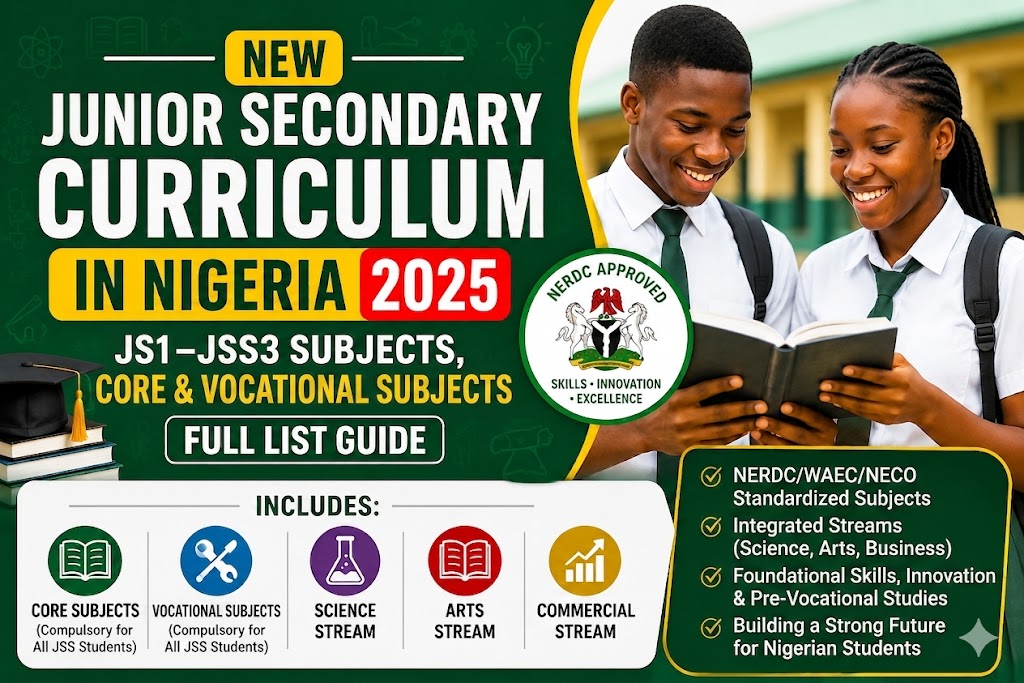
In 2025, Nigeria introduced important updates to the Junior Secondary School curriculum as part of the ongoing education reform coordinated by the Nigerian Educational Research and Development Council (NERDC).
The revised curriculum is designed to reduce excessive theoretical learning and focus more on practical knowledge, digital literacy, entrepreneurship, and skill acquisition.
Under the updated system, students in JSS1 to JSS3 now study a combination of core academic subjects, vocational subjects, ICT-related courses, and trade subjects aimed at preparing them for both higher education and real-life skills.
The curriculum is currently being implemented across public and private secondary schools in Nigeria.
2. What is Junior Secondary School in Nigeria?
Junior Secondary School (JSS) is the first stage of secondary education in Nigeria after primary school.
It covers:
- JSS1
- JSS2
- JSS3
At this level, students build foundational knowledge in:
- Science
- Mathematics
- Languages
- Technology
- Civic education
- Entrepreneurship
JSS3 students also prepare for the Basic Education Certificate Examination (BECE).
3. Overview of the New 2025 Curriculum Reform
The updated curriculum introduced by NERDC focuses on:
- Skill acquisition
- Entrepreneurship education
- Digital literacy
- Reduction of overloaded subjects
- Practical learning
- Career awareness from an early stage
The goal is to help Nigerian students become:
- Creative
- Innovative
- Technologically aware
- Self-reliant
4. Structure of JSS1–JSS3 Subjects
The junior secondary curriculum is grouped into:
✔ Core Subjects
✔ Pre-Vocational Subjects
✔ Trade Subjects
✔ Civic and Cultural Subjects
✔ ICT / Digital Technology Subjects
Students study both academic and practical subjects.
5. Core Compulsory Subjects
These are compulsory for all students:
📘 English Studies
- Grammar
- Comprehension
- Essay writing
- Oral English
📗 Mathematics
- Algebra
- Fractions
- Geometry
- Statistics
🔬 Basic Science
- Living things
- Energy
- Environment
- Human body systems
🌍 Social Studies
- Culture and society
- Citizenship
- National unity
- Family values
6. Pre-Vocational Subjects
These subjects help students develop practical life skills.
⚙️ Basic Technology
- Technical drawing
- Tools and machines
- Workshop safety
🌾 Agricultural Science
- Crop production
- Animal farming
- Soil science
🏡 Home Economics
- Nutrition
- Clothing and textiles
- Home management
7. ⭐ Trade / Entrepreneurship Subjects
One major part of the new curriculum is the introduction and expansion of trade subjects.
Students may study areas such as:
- Fashion Design
- Catering Craft Practice
- GSM Repairs
- Plumbing
- Electrical Installation
- Hairdressing and Cosmetology
- Carpentry and Joinery
- Photography
- Painting and Decoration
Importance of Trade Subjects
- Encourages self-employment
- Develops practical skills
- Reduces unemployment
- Builds entrepreneurship mindset
8. Cultural, Civic and Language Subjects
🎭 Cultural and Creative Arts (CCA)
- Music
- Drama
- Fine arts
- Crafts
🏛 Civic Education
- Human rights
- Democracy
- National values
🗣 Nigerian Languages
Depending on region:
- Yoruba
- Igbo
- Hausa
✝️ Religious Studies
Students study:
- CRS
or - IRS
9. ICT and Digital Technology Subjects
The new curriculum places strong emphasis on technology.
Students learn:
- Computer basics
- Word processing
- Internet safety
- Digital communication
- Basic coding awareness
10. Subject Combination and Learning Areas
Unlike senior secondary school, JSS students generally study all compulsory subjects together.
However, schools may allow students to focus more on:
- Technical skills
- Science skills
- Creative arts
- Entrepreneurship subjects
as they progress toward senior secondary education.
11. BECE Examination Subjects
At the end of JSS3, students write the Basic Education Certificate Examination (BECE).
Subjects usually include:
- English Studies
- Mathematics
- Basic Science
- Social Studies
- Civic Education
- Basic Technology
- Agricultural Science
- Home Economics
- ICT
- CCA
- CRS / IRS
12. Importance of the New Junior Secondary Curriculum
The updated curriculum helps students:
- Gain practical skills early
- Improve digital literacy
- Prepare for modern careers
- Become self-reliant
- Develop problem-solving abilities
13. Benefits of Trade Subjects for Students
Trade subjects are important because they:
- Encourage entrepreneurship
- Teach employable skills
- Reduce dependency on white-collar jobs
- Promote creativity and innovation
Students can begin learning income-generating skills while still in school.
14. Common Challenges Students Face
❌ Challenges
- Difficulty adapting to practical learning
- Lack of learning materials
- Poor ICT access in some schools
- Limited vocational equipment
✅ Solutions
- Better school funding
- Improved teacher training
- More ICT facilities
- Increased practical learning sessions
15. How Students Can Excel Under the New Curriculum
Students should:
- Study consistently
- Participate in practical classes
- Learn digital skills early
- Practice trade subjects seriously
- Avoid distractions
16. FAQs
1. Is the new curriculum already active in Nigeria?
Yes, implementation began progressively in 2025.
2. Are trade subjects compulsory?
Trade and vocational learning are now strongly emphasized under the revised curriculum.
3. Who designed the curriculum?
The curriculum was developed by NERDC with the Federal Ministry of Education.
4. What exam do JSS3 students write?
Students write the Basic Education Certificate Examination (BECE).
17. Conclusion
The New Junior Secondary Curriculum in Nigeria 2025 represents a major step toward practical, skill-based, and technology-driven education.
By combining core academic subjects with entrepreneurship, ICT, and trade education, the curriculum aims to prepare Nigerian students for both higher education and real-world opportunities.
Students who take advantage of the new system can develop valuable skills that will benefit them academically, professionally, and financially in the future.

You must be logged in to post a comment.