

Introduction
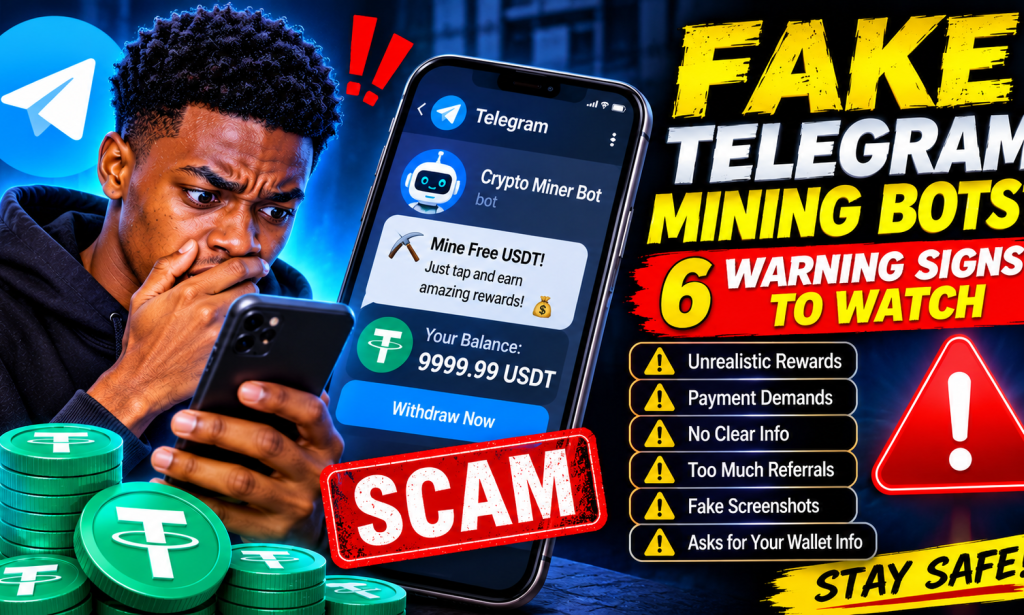
Imagine opening Telegram and discovering a bot that promises free cryptocurrency simply for tapping a button every few hours. Your balance keeps increasing, the community is celebrating, and people are sharing screenshots of their supposed earnings.
It sounds exciting, especially when you are hoping to earn something without spending money.
However, there is an important question: Are those displayed tokens actually worth anything?
Telegram mining bots have become popular because they make cryptocurrency projects accessible to ordinary users. But a growing balance on a screen does not automatically mean you own valuable cryptocurrency. Some projects may never launch a transferable token, while others may use fake rewards to encourage users to pay money or share sensitive information.
Here are important warning signs to understand before trusting a Telegram mining bot.
1. The Bot Promises Unrealistic Rewards
One major warning sign is a promise of enormous earnings for almost no effort.
A bot might claim that users can earn thousands of dollars simply by checking in daily, tapping a button or inviting a few friends. It may also promise guaranteed profits or a specific future token price.
Be careful with these claims. Cryptocurrency values are unpredictable, and no project can honestly guarantee that a token will make you rich.
The US Federal Trade Commission warns that guaranteed cryptocurrency profits and promises of free money are common scam tactics. <Cite refs={["turn740170search0","turn740170search2"]}/>
2. It Demands Payment Before You Can Withdraw
This is one of the most important warning signs.
Imagine mining tokens for several weeks. When you finally request a withdrawal, the bot suddenly tells you to pay an activation fee, verification deposit, tax or upgrade charge before receiving your earnings.
Pause before doing anything.
A platform that keeps inventing new payments before releasing supposed earnings deserves serious suspicion. The FBI has warned about cryptocurrency job scams in which victims are shown fake balances and later asked to pay fees or deposits to unlock withdrawals. <Cite refs={["turn740170search3","turn740170search6"]}/>
Remember: never pay money simply because a Telegram bot claims you must pay to receive your rewards.
3. The Project Has No Clear Information
A trustworthy project should explain what it is building and how its token is supposed to work.
Before believing a mining bot's claims, look for basic information:
- Who is developing the project?
- What problem is the project trying to solve?
- Does it have an official website?
- Are its token details and distribution rules explained?
- Is there a clear way to contact the project team?
- Does it explain how withdrawals will work?
A project that provides no meaningful information, changes its explanations repeatedly or hides behind anonymous administrators should be approached cautiously.
A professional-looking logo and website are not proof of legitimacy.
4. It Depends Almost Entirely on Referrals
Referral programmes are common in online communities, and they are not automatically suspicious.
However, be careful when a bot makes referrals its main activity. If users are constantly encouraged to invite more people but receive no clear information about the actual product, token or withdrawal process, ask questions.
Some fraudulent schemes use referral rewards and fake success stories to create excitement and attract more participants. The FTC has also warned about online task scams that use group chats and displayed earnings to build trust before demanding deposits. <Cite refs={["turn740170search4","turn740170search5"]}/>
Do not invite friends into a project simply because you hope its promises will come true.
5. Screenshots Are Not Enough
You may see people posting screenshots of huge balances or successful withdrawals. Those screenshots can be interesting, but they do not prove that a project is safe.
A screenshot can show an in-app balance without proving that the tokens exist on a blockchain or can be transferred.
For stronger evidence, look for independently verifiable blockchain transactions. Even then, one successful transaction does not prove that the entire project is trustworthy.
Check the token's actual network, contract details and whether it can be transferred. Do not assume that a token has real market value simply because it appears inside a Telegram bot.
6. It Requests Sensitive Wallet Information
Your cryptocurrency wallet is important, so protect it.
Never share your wallet recovery phrase, private key, passwords or Telegram login codes with a bot or administrator. Treat unexpected links and files with caution.
Telegram's official FAQ advises users to treat bots like strangers and never give them passwords or Telegram codes. <Cite refs={["turn740170search7"]}/>
If a bot asks for information that would give someone control over your wallet or account, stop interacting with it.
A Simple Safety Checklist Before Joining
Before spending time on a Telegram mining project, ask yourself:
- Does it explain what the project actually does?
- Are its withdrawal conditions clear from the beginning?
- Does it avoid demanding deposits to unlock supposed earnings?
- Can its token and blockchain information be independently checked?
- Does it protect users' passwords and wallet recovery information?
- Are its claims realistic and supported by evidence?
If several answers are unclear, do not rush to join. You do not need to participate in every trending mining bot.
What Should You Do If You Suspect a Scam?
Stop sending money or sharing information. Do not pay additional fees to recover supposed earnings. Save relevant messages and transaction records, block suspicious accounts and report the activity through appropriate channels.
If you have already shared a wallet recovery phrase or private key, treat that wallet as compromised and seek help from a trusted adult or knowledgeable wallet-support professional. Never pay someone who promises to recover lost cryptocurrency for an upfront fee.
Protect Your Time and Your Money
Telegram mining can look simple, but a growing number on a screen is not the same as money in your wallet. Take time to investigate projects, question unrealistic promises and protect your personal information.
If this article helped you, please like it, follow my LodPost profile, share it with someone who may need it, and leave a comment with your thoughts.
I also welcome donations to support my writing. I started writing to help provide for my mother, who has cancer, and raise money towards her surgery. Every donation, no matter the amount, would mean a great deal and help me continue creating useful content. Thank you for reading and supporting my work.


You must be logged in to post a comment.