

China’s AI Bubble Has Burst: $480 Billion Wiped Out as Tech Stocks Crash in 2026
Artificial intelligence has been one of the biggest technology and investment stories of recent years. From advanced computer chips to humanoid robots and powerful AI models, investors have poured money into companies they believe could shape the future of the global economy.
However, China's technology market has recently experienced a dramatic reversal.
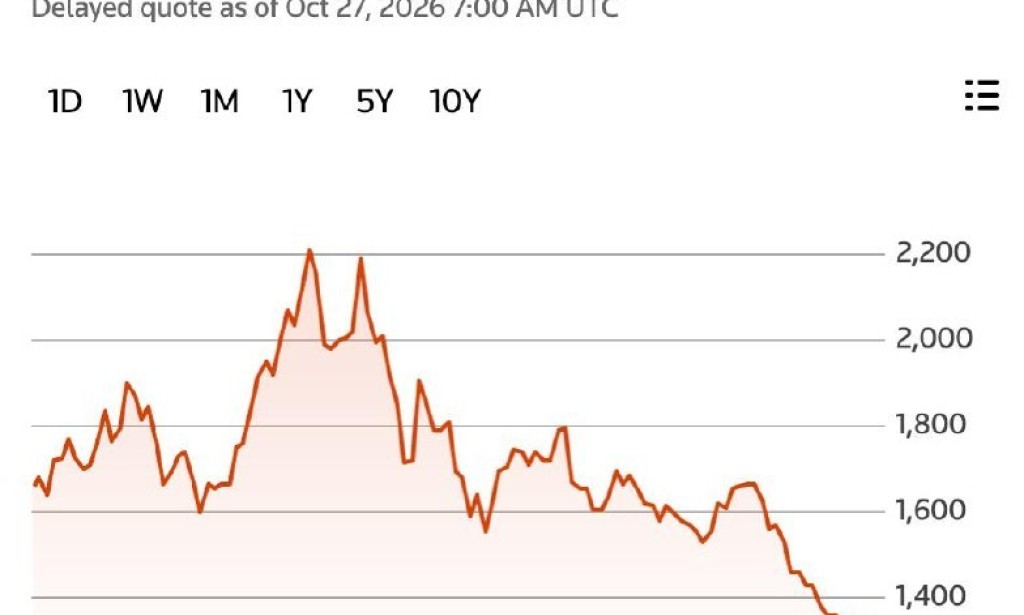
According to a Reuters report published on October 26, 2026, China's STAR50 index, which tracks leading technology and semiconductor companies, has fallen approximately 40% in less than four months. The decline has erased an estimated $480 billion in market value. Reuters
The sell-off has reignited an important debate: did investors become so excited about artificial intelligence that they pushed company valuations far beyond what their businesses could reasonably justify?
Although the downturn does not mean AI technology has failed, it demonstrates how quickly financial enthusiasm can turn into widespread losses when expectations become unrealistic.
How China's AI Investment Boom Turned Into a Crash
China's AI-related shares experienced a powerful rally as investors became increasingly optimistic about domestic technology companies, semiconductor manufacturing, robotics, and government support for technological development.
Many investors believed these industries would benefit from rising AI adoption and China's efforts to strengthen its domestic technology capabilities.
As share prices climbed, more investors wanted to participate. The growing excitement helped push valuations higher, attracting additional attention from people hoping to benefit from the boom.
However, rising share prices do not automatically mean companies are becoming more profitable.
When investors pay increasingly high prices based on expectations of future growth, companies may become vulnerable if earnings, demand, or business performance fail to meet those expectations.
That appears to be one of the central problems facing China's AI-related stocks.
Reuters reported that the STAR50 index had fallen around 40% from its July peak, while China's broader CSI300 blue-chip index had declined approximately 20% from its June high. MarketScreener
The scale of the reversal shows how an investment theme that once attracted enormous enthusiasm can become a source of financial anxiety.
Approximately $480 Billion in Market Value Has Disappeared
The reported $480 billion loss is one of the most striking figures associated with the downturn.
However, it is important to understand what that number means.
Market value, also known as market capitalisation, represents the combined market value of a company's outstanding shares. When share prices decline, the total market capitalisation of the affected companies falls.
This does not necessarily mean that $480 billion in cash was physically withdrawn from company bank accounts. Instead, it reflects the reduction in the market value of shares following the sell-off.
Nevertheless, the consequences can be significant for investors who bought at higher prices.
Some may decide to sell their holdings, while others may hold on and wait for prices to recover. Companies planning to raise money through share offerings may also face more difficult conditions when investors become less willing to pay high valuations.
The downturn therefore affects more than the daily movement of stock prices. It can influence confidence, fundraising, and the willingness of investors to support new technology ventures.
The Companies Feeling the Pressure
Several prominent Chinese technology companies have experienced substantial share-price declines.
Reuters identified robotics maker Unitree, semiconductor companies CXMT, MetaX Integrated Circuits and Moore Threads Technology, and optical-component manufacturers Zhongji Innolight and Eoptolink Technology among the businesses affected by the sell-off. MarketScreener
These companies operate in different parts of the technology ecosystem, including robotics, chip manufacturing, and equipment used in data-centre infrastructure.
Their difficulties illustrate an important feature of the AI investment boom: investors have not concentrated their enthusiasm exclusively on companies developing AI software. They have also invested heavily in businesses supplying the hardware and infrastructure needed to support the industry.
That creates risks when expectations about future spending change.
If investors begin questioning how quickly AI infrastructure demand will grow, they may reconsider the valuations of semiconductor suppliers, robotics companies, and other businesses connected to the technology.
The resulting pressure can spread across several related industries, even when individual companies have different products, customers, and financial positions.
Why Did Investor Confidence Collapse?
There was no single confirmed trigger responsible for the entire sell-off. Instead, several concerns appear to have contributed to the reversal.
Extremely high valuations: When shares rise faster than the underlying businesses' earnings, investors may become concerned that future growth has already been priced in. Reuters reported that the STAR50's valuation remained elevated even after the decline. MarketScreener
Questions about future demand: AI technology has enormous potential, but investors must still determine whether demand for chips, robotics, and data-centre equipment will justify the prices they are paying for related companies.
Tax-related selling pressure: Reuters reported that some market participants pointed to tax bills falling due as one factor contributing to selling activity.
Possible export restrictions: Concerns about restrictions affecting Chinese technology suppliers' access to overseas markets, particularly US data centres, have also placed pressure on some businesses.
Together, these issues have challenged the belief that every company associated with artificial intelligence will automatically become a major financial winner.
The lesson is that technological importance and investment attractiveness are not the same thing. A company can operate in a promising industry while still being valued too highly.
The AI Industry Is Not Necessarily Collapsing
Despite the dramatic headlines, China's stock-market downturn should not be interpreted as proof that artificial intelligence is disappearing or becoming useless.
There is an important distinction between a technology's long-term prospects and the price investors are willing to pay for companies associated with it.
For example, a business may develop useful AI products and still experience falling share prices if investors previously expected unrealistic levels of growth.
Similarly, demand for AI services can continue increasing even while some technology companies struggle with profitability, competition, or excessive valuations.
The current situation may therefore represent a correction in financial expectations rather than the end of AI development.
However, it could still have lasting consequences. Investors may become more selective, companies may face greater pressure to demonstrate revenue growth, and businesses with weak financial foundations could struggle to attract new funding.
The distinction matters because the future of AI will depend not only on technological breakthroughs but also on whether companies can turn those breakthroughs into sustainable businesses.
Could China's AI Crash Affect the Rest of the World?
China's downturn is attracting international attention because artificial intelligence has become a major investment theme across global markets.
Reuters noted that the decline in China's STAR50 index was much steeper than the roughly 6% pullback in the Nasdaq from its recent record high at the time of its report. MarketScreener
That comparison highlights the severity of the Chinese sell-off, but it does not prove that other markets will experience the same decline.
Different countries have different companies, valuations, regulations, and sources of investor demand.
Nevertheless, the Chinese experience offers a warning for markets where investors have become highly optimistic about AI-related businesses.
If investors begin questioning whether expected profits justify current share prices, companies across the technology industry could face increased scrutiny.
Investors may also become more interested in financial fundamentals, including revenue, profitability, cash flow, competition, and the ability to maintain growth over time.
For technology businesses, demonstrating real commercial value could become increasingly important as enthusiasm alone becomes less convincing.
What Happens Next?
The next phase will depend on whether companies can demonstrate that their business prospects justify their valuations.
Some investors may interpret the decline as an opportunity to reassess companies whose share prices have fallen substantially. Others may remain cautious until valuations become more attractive or business performance improves.
There is no guarantee that the market has reached its lowest point. Share prices could recover, remain volatile, or decline further.
The downturn may also influence future technology listings. When investors become more cautious, newly listed companies can find it harder to attract funding at the valuations their founders previously expected.
For China's technology sector, the challenge will be maintaining long-term innovation while rebuilding investor confidence.
For the wider world, the episode reinforces a broader principle: exciting technologies can create genuine opportunities, but investment bubbles can still develop around them.
Final Thoughts
China's AI stock crash is a significant reminder that even industries with promising long-term potential can experience severe market corrections.
With approximately $480 billion in market value erased and the STAR50 index down around 40% in less than four months, investors have been forced to reconsider the assumptions that supported the earlier rally. Reuters
The most important question is no longer simply whether artificial intelligence will transform the economy. It is whether individual companies can turn that potential into sustainable earnings at valuations investors can justify.
AI may continue developing rapidly, but the financial markets supporting it will not necessarily move in a straight line.
Do you think China's AI stock crash is a warning that the global AI investment bubble could burst next, or is this simply a correction in an industry with a promising future?
If you found this article informative, please like it, leave a comment, share it with others interested in technology and business, and follow my profile for more news updates. You can also donate to support my writing and help me publish more useful articles.
Disclaimer: This article is for informational purposes only and is not financial or investment advice. Market conditions can change rapidly, and past price movements do not guarantee future performance.


You must be logged in to post a comment.