

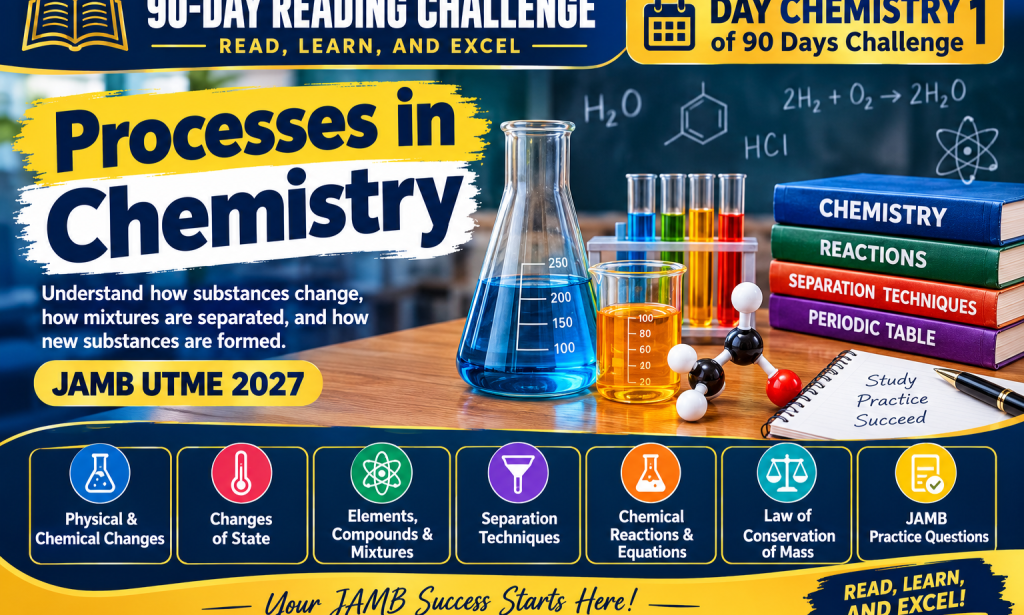
DAY CHEMISTRY 1 OF 90 DAYS CHALLENGE: PROCESSES IN CHEMISTRY
Category: Education / Chemistry
Target Audience: JAMB UTME 2027 Candidates and Secondary School Students
Challenge: Day Chemistry 1 of 90 Days Reading Challenge
Introduction
Chemistry is the branch of science that studies the composition, properties and changes of matter. It helps us understand the substances around us, how they interact, and how useful products are made from raw materials.
From cooking food and washing clothes to manufacturing medicines, fertilisers, soaps and fuels, chemistry plays an important role in our daily lives.
One of the fundamental areas of chemistry is processes in chemistry. Understanding these processes helps students explain how substances change, how mixtures can be separated, and how new substances are formed.
For students preparing for JAMB UTME 2027, mastering the basic concepts in this topic provides a strong foundation for more advanced chemistry lessons.
1. What Is a Chemical Process?
A chemical process involves the transformation of substances through chemical reactions or other chemical operations.
During a chemical reaction, the atoms in the starting substances rearrange to form new substances with different properties.
For example, when iron reacts with oxygen and moisture, rust forms. The rust has properties different from those of the original iron.
Chemical processes are important in industries, agriculture, medicine, food production and environmental management.
However, not every process studied in chemistry produces a new substance. Some processes involve only physical changes, such as melting ice or separating sand from water.
2. Physical and Chemical Changes
Changes in matter can generally be classified as physical changes or chemical changes.
A. Physical Changes
A physical change affects the form, size, shape or state of a substance without producing a new substance.
Examples include:
- Melting ice into liquid water.
- Boiling water to produce water vapour.
- Freezing water into ice.
- Dissolving sugar in water.
- Cutting a piece of paper into smaller pieces.
In these examples, the chemical identity of the substance remains unchanged.
For instance, ice, liquid water and water vapour are different physical states of the same substance, H₂O.
Many physical changes can be reversed, although reversibility alone does not determine whether a change is physical or chemical.
B. Chemical Changes
A chemical change occurs when one or more substances are converted into new substances with different chemical properties.
Examples include:
- Rusting of iron.
- Burning of wood.
- Cooking an egg.
- Digestion of food.
- Reaction between an acid and a suitable metal.
During these changes, chemical reactions occur and new substances are formed.
Common signs of a chemical reaction may include a colour change, gas production, formation of a precipitate, or a temperature change. However, no single sign proves that a chemical reaction has occurred in every case.
Differences Between Physical and Chemical Changes
Physical change| Chemical change
No new substance is formed.| One or more new substances are formed.
The chemical identity remains the same.| The chemical composition changes.
Examples include melting and freezing.| Examples include rusting and burning.
Often easier to reverse.| Often more difficult to reverse.
Understanding this distinction is important when answering objective chemistry questions.
3. Changes of State of Matter
Matter commonly exists as a solid, liquid or gas. Changes in temperature or pressure can cause a substance to change from one state to another.
The main changes of state are:
Melting: The change from solid to liquid, such as ice melting into water.
Freezing: The change from liquid to solid, such as water turning into ice.
Vaporisation: The change from liquid to gas, including boiling and evaporation.
Condensation: The change from gas to liquid, such as water vapour forming droplets on a cold surface.
Sublimation: The direct change from solid to gas without passing through the liquid state.
Deposition: The direct change from gas to solid without passing through the liquid state.
These processes are generally physical changes because the chemical identity of the substance remains unchanged.
For example, when water evaporates, it changes from liquid water to water vapour, but it remains H₂O.
4. Elements, Compounds and Mixtures
To understand chemical processes properly, students must distinguish between elements, compounds and mixtures.
A. Elements
An element is a pure substance consisting of only one type of atom.
Examples include iron (Fe), oxygen (O), hydrogen (H) and copper (Cu).
Elements cannot be broken down into simpler substances by ordinary chemical reactions.
B. Compounds
A compound is a pure substance formed when two or more different elements combine chemically in a fixed proportion.
Examples include:
- Water (H₂O).
- Carbon dioxide (CO₂).
- Sodium chloride (NaCl).
- Ammonia (NH₃).
Compounds have properties that may differ significantly from those of their constituent elements.
For example, sodium is a highly reactive metal, and chlorine is a poisonous gas, but sodium chloride is the familiar compound known as common salt.
C. Mixtures
A mixture contains two or more substances physically combined without forming a new compound through a chemical reaction.
Examples include air, soil, salt water and a mixture of sand and iron filings.
The components of a mixture retain their individual chemical identities and can often be separated using suitable physical methods.
Mixtures may be homogeneous, with a uniform composition throughout, or heterogeneous, with visibly or otherwise distinguishable components.
5. Separation Techniques in Chemistry
Separating mixtures is an important practical application of chemistry. The method selected depends on the properties of the substances in the mixture.
A. Filtration
Filtration separates an insoluble solid from a liquid using a filter.
Example: Separating sand from water.
The sand remains on the filter paper as residue, while the water passes through as filtrate.
B. Evaporation
Evaporation can be used to recover a dissolved solid from a solution by allowing the solvent to escape as vapour.
Example: Obtaining salt from salt water.
C. Crystallisation
Crystallisation is used to obtain solid crystals of a dissolved substance from a suitable solution.
It can produce purer crystals than simple evaporation to dryness when performed under appropriate conditions.
D. Distillation
Distillation separates substances by vaporising a component and then condensing its vapour.
Simple distillation can be used to recover a solvent from a solution, while fractional distillation is useful for separating suitable mixtures of liquids with different boiling points.
Example: Obtaining purified water from salt water by distillation.
E. Chromatography
Chromatography separates components of a mixture based on their different movements through a stationary medium under the influence of a mobile phase.
Example: Separating the different dyes in some inks using paper chromatography.
F. Separating with a Magnet
A magnet can separate magnetic materials from non-magnetic materials.
Example: Separating iron filings from sand.
Students should remember that separation techniques generally separate the components of mixtures without changing their chemical identities.
6. Chemical Reactions and Chemical Equations
A chemical reaction occurs when substances called reactants are transformed into products.
A chemical equation represents a chemical reaction using chemical symbols and formulae.
Consider the formation of water:
2H₂ + O₂ → 2H₂O
In this equation:
- Hydrogen and oxygen are the reactants.
- Water is the product.
- The numbers in front of the formulae are called coefficients.
- The equation is balanced because the number of hydrogen and oxygen atoms is the same on both sides.
Why Must Chemical Equations Be Balanced?
Chemical equations must be balanced because atoms are conserved during ordinary chemical reactions.
Atoms are rearranged, but they are not ordinarily created or destroyed in a chemical reaction.
For example:
H₂ + O₂ → H₂O
This equation is not balanced because there are two oxygen atoms on the left but only one on the right.
The balanced equation is:
2H₂ + O₂ → 2H₂O
There are now four hydrogen atoms and two oxygen atoms on each side.
Learning to balance chemical equations is an essential skill for chemistry students.
7. The Law of Conservation of Mass
The law of conservation of mass states that mass is conserved during an ordinary chemical reaction in a closed system.
This means that the total mass of the reactants equals the total mass of the products.
For example, if 12 g of carbon reacts completely with 32 g of oxygen, the mass of carbon dioxide formed is:
12 g + 32 g = 44 g.
Therefore, 44 g of carbon dioxide is produced, assuming the reaction is complete and all the product is accounted for.
This law explains why chemical equations must be balanced.
8. Importance of Chemical Processes in Everyday Life
Chemical processes are useful in many areas of human life.
Medicine: Chemical processes are used to manufacture medicines and develop substances for treating diseases.
Agriculture: Fertilisers and other agricultural chemicals are produced through industrial chemical processes.
Food production: Baking, fermentation and food preservation involve chemical changes or chemical processes.
Water treatment: Suitable physical and chemical processes help remove impurities and make water safer for its intended use.
Manufacturing: Industries use chemical reactions to produce materials such as plastics, paints, detergents and cement.
Environmental protection: Chemistry helps scientists study air pollution, water contamination, waste treatment and methods of reducing environmental damage.
Understanding chemistry therefore helps us appreciate how science improves everyday life.
9. JAMB UTME Practice Questions
Test your understanding by answering these questions before checking the answers.
Question 1: Which of the following is an example of a physical change?
A. Rusting of iron
B. Burning of wood
C. Melting of ice
D. Cooking an egg
Question 2: Which method is most suitable for separating sand from water?
A. Filtration
B. Distillation
C. Chromatography
D. Crystallisation
Question 3: Which of the following is a compound?
A. Iron
B. Oxygen
C. Water
D. Copper
Question 4: The direct change of a solid into a gas is called:
A. Condensation
B. Sublimation
C. Freezing
D. Melting
Question 5: Which separation technique can be used to separate the different dyes in ink?
A. Filtration
B. Magnetic separation
C. Chromatography
D. Decantation
Question 6: What is the correct balanced equation for the formation of water from hydrogen and oxygen?
A. H₂ + O₂ → H₂O
B. 2H₂ + O₂ → 2H₂O
C. H₂ + 2O₂ → H₂O
D. 2H₂ + 2O₂ → H₂O
Answers and Explanations
1. C — Melting of ice. It changes the state of water without forming a new substance.
2. A — Filtration. It separates an insoluble solid from a liquid.
3. C — Water. Water contains hydrogen and oxygen chemically combined in a fixed ratio.
4. B — Sublimation. It is the direct change from solid to gas.
5. C — Chromatography. It separates mixture components according to their different movements through a medium.
6. B — 2H₂ + O₂ → 2H₂O. This equation has equal numbers of hydrogen and oxygen atoms on both sides.
10. How to Study This Topic Effectively
For students participating in the 90-Day Reading Challenge, the following study habits can improve understanding:
1. Read the lesson carefully and write down important definitions.
2. Learn the differences between physical and chemical changes.
3. Memorise the names and uses of common separation techniques.
4. Practise balancing simple chemical equations.
5. Solve JAMB-style questions and study the explanations.
6. Revise the topic before moving to the next lesson.
Do not rely on memorisation alone. Try to understand why each process occurs and how the concepts apply to real-life examples.
Conclusion
Processes in chemistry help us understand how substances change, how mixtures can be separated, and how chemical reactions produce new substances.
By learning about physical and chemical changes, states of matter, elements, compounds, mixtures, separation techniques, chemical equations and conservation of mass, students can build a strong foundation for more advanced chemistry topics.
For candidates preparing for JAMB UTME 2027, consistent study and regular practice are essential. Use this first Chemistry lesson to test your knowledge, correct your mistakes and prepare for the next stage of the challenge.
READ, LEARN, AND EXCEL!
---


You must be logged in to post a comment.