
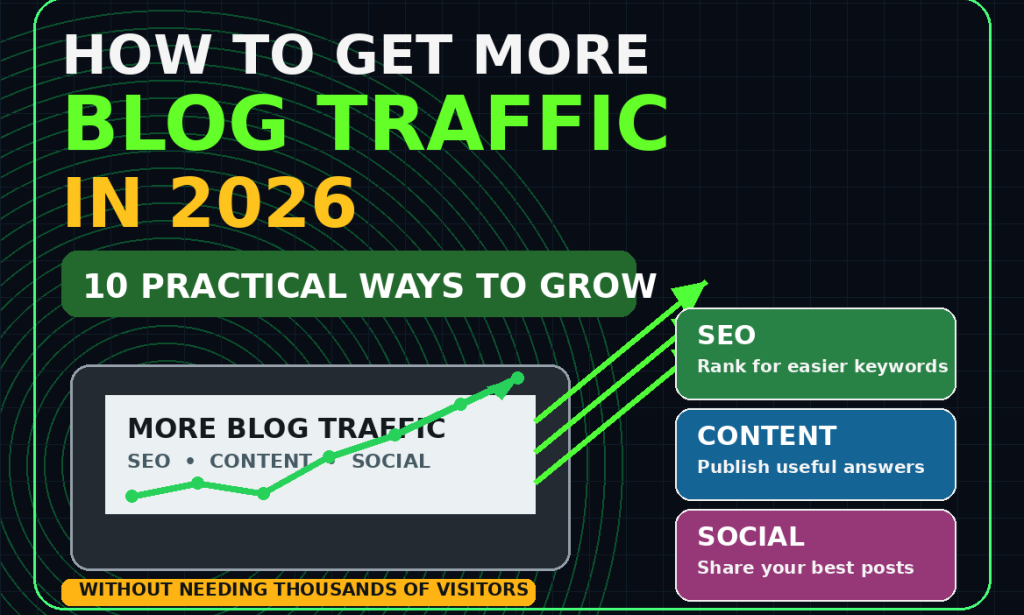
How to Get More Blog Traffic in 2026 Without Spending Money
Complete Step-by-Step Guide
Starting a blog is easy.
Getting people to actually visit it is much harder.
Many new bloggers publish an article, wait a few days, check their analytics, and wonder why nobody is visiting.
The problem isn't necessarily that the content is bad.
A blog needs visibility, consistency, and promotion.
The good news is that you don't need a large advertising budget to start getting traffic.
There are many free methods you can use to attract visitors from search engines, social platforms, communities, email, and other websites.
This guide explains practical ways to grow blog traffic in 2026 without spending money on advertising.
Step 1: Understand Where Blog Traffic Comes From
Before trying to increase traffic, understand the major sources.
Blog traffic can come from:
-
Google and other search engines
-
Social media
-
Online communities
-
Email
-
Other websites
-
Direct visitors
-
Referrals
-
Video platforms
You don't need to master every source.
Start with two or three channels that fit your audience.
For most blogs, SEO and content promotion are excellent places to begin.
Step 2: Choose Topics People Actually Search For
One of the easiest ways to waste time is writing about topics nobody cares about.
Before creating an article, ask:
“Does anyone have a reason to search for this?”
Use free research methods such as:
-
Google Autocomplete
-
People Also Ask
-
Related searches
-
Reddit discussions
-
YouTube searches
-
Quora questions
-
Google Trends
-
Keyword Planner
Look for questions and problems your audience is already trying to solve.
For example, instead of writing:
Blogging Tips
try something more specific:
How to Get Your First 100 Blog Visitors
The second topic gives you a much clearer audience and search intent.
Step 3: Target Long-Tail Keywords
New websites often struggle to compete for extremely broad keywords.
Instead of targeting:
SEO
try:
SEO tips for new bloggers
Instead of:
Email marketing
try:
How to build an email list from a small blog
Long-tail keywords usually have fewer words searching for them, but they can be much more specific.
Specific searches can also make it easier to create content that directly answers the searcher's question.
Step 4: Create Better Content Than What's Already Ranking
Search Google for your target topic.
Look at the first page.
Ask:
-
Is the information outdated?
-
Are important questions unanswered?
-
Is the article difficult to read?
-
Are there few examples?
-
Is the content too short?
-
Does it lack practical instructions?
-
Could you explain the topic more clearly?
Don't simply make your article longer.
Make it more useful.
Add:
-
Examples
-
Screenshots
-
Checklists
-
Templates
-
Original insights
-
Step-by-step instructions
-
Updated information
Your goal is to create the resource you would personally want to find.
Step 5: Write Strong Blog Titles
Your title is one of the first things a potential visitor sees.
Compare:
Blog Traffic Tips
with:
15 Free Ways to Get More Blog Traffic in 2026
The second is more specific and tells the reader what to expect.
Good titles should be:
-
Clear
-
Specific
-
Useful
-
Accurate
-
Relevant to the search
Avoid misleading clickbait.
A high-click title is useless if the article doesn't deliver what it promises.
Step 6: Optimize Your Articles for Search Intent
Search intent means understanding what someone actually wants when they search.
For example:
“How to start a blog”
usually indicates informational intent.
The person wants instructions.
“Best blogging platform”
suggests comparison or commercial intent.
The person may be evaluating options.
“WordPress vs Blogger”
suggests that the searcher wants a direct comparison.
Match your article to the intent.
If someone wants a tutorial, give them a tutorial.
If they want a comparison, provide a comparison.
Step 7: Improve Your On-Page SEO
You don't need complicated SEO software to improve a blog post.
Pay attention to:
-
Page title
-
Main heading
-
Subheadings
-
URL
-
Introduction
-
Internal links
-
Image descriptions where appropriate
-
Natural keyword usage
-
Readability
Don't stuff the same keyword into every paragraph.
Write naturally.
Search engines are trying to understand the topic and usefulness of your content, not simply count how many times you repeat a phrase.
Step 8: Add Internal Links
Internal links are links from one page on your website to another page on the same website.
They are extremely useful.
Imagine you have these articles:
-
How to Start a Blog
-
How to Do Keyword Research
-
How to Write Blog Titles
-
How to Get Backlinks
-
How to Make Money Blogging
You can connect them together naturally.
When writing about keyword research, link to your keyword research guide.
When writing about backlinks, link to your SEO guide.
This helps readers discover more content and helps search engines understand your site's structure.
Step 9: Update Old Articles
You don't always need to publish something new.
Sometimes your existing content has untapped potential.
Look at older articles and ask:
-
Is the information still accurate?
-
Can I add new examples?
-
Can I improve the title?
-
Can I answer more questions?
-
Can I improve the introduction?
-
Can I add internal links?
-
Can I make the article easier to read?
Updating useful content can be an efficient way to improve your website.
This is particularly important for topics that change frequently.
Step 10: Promote Every Important Article
Don't assume publishing means people will automatically find your article.
Once you publish something valuable, tell people about it.
You can share it through:
-
Facebook
-
LinkedIn
-
X
-
Pinterest
-
Relevant online communities
-
Email newsletters
-
Industry groups
Don't simply post:
“New article! Read it here.”
Instead, share something useful from the article.
For example:
“I tested five free ways to find blog keywords and found that one method was especially useful for new websites. Here's the complete process...”
Then provide the article.
Give people a reason to click.
Step 11: Use Online Communities
Online communities can be excellent sources of traffic when used correctly.
Look for communities where your target audience already participates.
These might include:
-
Reddit
-
Quora
-
Facebook groups
-
Industry forums
-
Professional communities
-
Niche discussion groups
Don't spam links.
Instead:
-
Find a real question.
-
Provide a useful answer.
-
Explain the solution.
-
Include your article only when it genuinely adds value.
-
Follow the community's rules.
Your goal should be to become useful rather than promotional.
Step 12: Turn Reddit Questions Into Blog Ideas
Reddit can be particularly useful for content research.
Search for your topic and look at questions people repeatedly ask.
For example, if you have a blogging website, you may discover questions such as:
-
How long does it take to get blog traffic?
-
How many articles should a new blog publish?
-
Why isn't my blog getting visitors?
-
How do I find low-competition keywords?
These questions can become excellent article ideas.
You are essentially using real conversations to understand what your audience needs.
Step 13: Use YouTube for Content Research
You don't need to create videos to benefit from YouTube.
Search your topic.
Look at:
-
Video titles
-
Popular questions
-
Comments
-
Suggested searches
-
Frequently discussed problems
If people repeatedly ask the same question in video comments, that's a potential blog topic.
You can then create a detailed written answer.
Step 14: Build an Email List
Email can bring visitors back to your website.
Imagine someone reads one article today and leaves.
Without an email list, they may never return.
Give visitors a reason to subscribe.
You could offer:
-
Free checklist
-
Template
-
Guide
-
Newsletter
-
Resource list
-
Mini-course
Then send useful emails whenever you publish important content.
Even a small email list can become a reliable source of returning traffic.
Step 15: Create Content Clusters
Instead of writing completely unrelated articles, create groups of connected content.
For example, a blogging website could create a cluster around SEO:
Main Guide
Complete Beginner's Guide to Blog SEO
Supporting Articles
-
How to Do Keyword Research
-
How to Write SEO Titles
-
How to Build Backlinks
-
How to Improve Internal Linking
-
How to Find Easy Ranking Topics
Then connect these articles with internal links.
This creates a stronger overall content structure.
Step 16: Create Free Tools and Resources
Free resources can attract attention.
Examples include:
-
Calculators
-
Templates
-
Checklists
-
Spreadsheets
-
Planners
-
Generators
-
Tutorials
-
Resource libraries
A useful free resource can sometimes attract links and social shares naturally.
You don't need to build a complicated software product.
Even a well-designed spreadsheet can be valuable.
Step 17: Get Backlinks Naturally
Backlinks are links from other websites to your website.
They can help with visibility and SEO.
Instead of buying thousands of questionable links, create content that deserves to be referenced.
Good link-worthy content includes:
-
Original research
-
Statistics
-
Detailed guides
-
Free tools
-
Unique case studies
-
Useful templates
-
Industry resources
You can also contact relevant website owners when your content genuinely adds value to an article they're publishing.
Step 18: Write Guest Posts
Another free traffic and visibility strategy is contributing useful articles to relevant websites.
Look for websites in your niche that accept legitimate contributions.
Write something genuinely useful.
Depending on the site's policies, you may be able to include an appropriate author or website link.
The goal should be to reach a relevant audience, not simply collect links.
Step 19: Create Shareable Statistics
Statistics are often referenced by bloggers and journalists.
If you can organize useful data into a clear article, other websites may reference it.
For example:
50 Blogging Statistics for 2026
or:
100 Email Marketing Statistics Every Blogger Should Know
Make sure your statistics are accurate and clearly sourced.
Don't invent numbers simply to make an article look impressive.
Step 20: Repurpose Your Best Articles
One blog post can become multiple pieces of content.
For example, one article could become:
-
LinkedIn posts
-
Facebook posts
-
X posts
-
Pinterest graphics
-
Short videos
-
Email content
-
Infographics
-
Social media carousels
This allows you to get more value from content you've already created.
You don't always need to produce something completely new.
Step 21: Create Pinterest-Friendly Content
For niches where Pinterest is relevant, create visual versions of your best articles.
For example:
10 Ways to Increase Blog Traffic
can become a visual checklist.
Someone sees the graphic, clicks through, and visits your article.
This can be particularly useful for niches such as:
-
Blogging
-
Food
-
Home improvement
-
Travel
-
Crafts
-
Education
-
Personal organization
Focus on platforms where your audience actually spends time.
Step 22: Improve Website Speed
Traffic growth isn't only about getting visitors.
You also need to give them a good experience.
A slow website can frustrate visitors.
Review:
-
Large images
-
Unnecessary plugins
-
Heavy themes
-
Excessive scripts
-
Poor hosting performance
-
Caching configuration
Compress images where appropriate and keep your website as simple as practical.
Step 23: Make Your Website Mobile-Friendly
A large portion of internet activity happens on mobile devices.
Check your website on:
-
Smartphones
-
Tablets
-
Desktop computers
Make sure:
-
Text is readable
-
Buttons are easy to tap
-
Menus work properly
-
Images don't overflow
-
Pages load efficiently
A visitor shouldn't have to zoom in and out just to read an article.
Step 24: Study Your Analytics
Don't guess what is working.
Look at your data.
Identify:
-
Most visited articles
-
Traffic sources
-
Search queries
-
Pages gaining impressions
-
Popular topics
-
Returning visitors
If one topic is performing well, create related content.
For example, if your article about keyword research gets significantly more traffic than your general blogging articles, create more content around keyword research.
Step 25: Be Consistent
You don't need to publish five articles every day.
Consistency is more important than extreme volume.
A realistic schedule might be:
1–2 useful articles per week
or whatever schedule you can maintain.
The important thing is to keep improving your website over time.
A Simple Free Blog Traffic Strategy
If you're starting from zero, use this system:
Step 1
Choose one specific audience.
Step 2
Find 20 questions they ask.
Step 3
Turn those questions into useful articles.
Step 4
Optimize the articles for search intent.
Step 5
Connect them with internal links.
Step 6
Share every important article.
Step 7
Build an email list.
Step 8
Update your best-performing articles.
Step 9
Create more content around successful topics.
Step 10
Track your results and improve.
Repeat the process.
Free Blog Traffic Checklist
-
Choose a specific audience
-
Research topics people actually search for
-
Target relevant long-tail keywords
-
Understand search intent
-
Write useful, comprehensive content
-
Create strong titles
-
Improve on-page SEO
-
Add internal links
-
Update old content
-
Promote new articles
-
Participate in relevant communities
-
Research questions on Reddit and YouTube
-
Build an email list
-
Create content clusters
-
Build useful free resources
-
Earn relevant backlinks
-
Repurpose your best content
-
Improve website speed
-
Make your website mobile-friendly
-
Monitor analytics
-
Stay consistent
Common Mistakes to Avoid
Publishing Without Promotion
Even excellent content needs distribution.
Targeting Only Huge Keywords
Large keywords can be extremely competitive.
Writing About Everything
A focused website can make it easier to establish topical relevance.
Ignoring Existing Content
Your old articles may have opportunities for improvement.
Buying Cheap Traffic
Large numbers don't necessarily mean valuable visitors.
Spamming Communities
This can damage your reputation and get your accounts restricted.
Giving Up Too Quickly
SEO and audience building often take time.
Final Thoughts
You don't need a huge budget to grow a blog in 2026.
You need a system.
Find topics people care about.
Create genuinely useful content.
Target specific searches.
Improve your existing articles.
Build internal links.
Promote your best work.
Participate in relevant communities.
Build an email audience.
Study your data.
Then repeat what works.
Don't become obsessed with getting thousands of visitors immediately.
Your first goal should be getting your first useful visitor, then your first 10, 100, and 1,000.
Every successful website starts somewhere.
Free traffic isn't really free—you invest time, effort, research, and consistency. But you don't need a large advertising budget to build an audience.
Start with one useful article today.
Then make the next one better.
Over time, those individual efforts can turn into a steady stream of visitors.

You must be logged in to post a comment.