
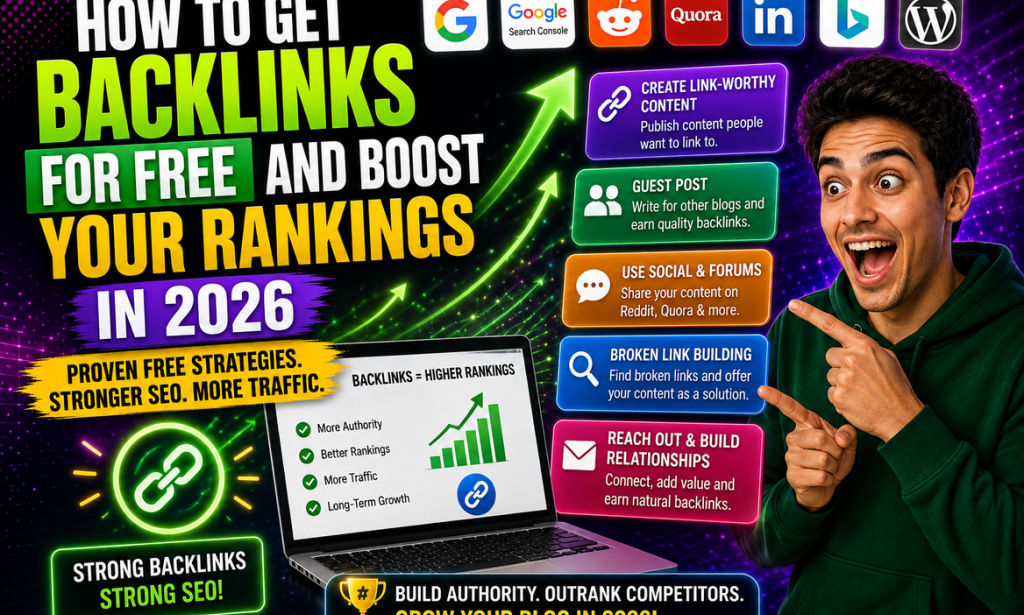
How to Get Backlinks for Free and Boost Your Rankings in 2026
Complete Step-by-Step Guide
Backlinks remain an important part of SEO because they can help search engines understand that other websites find your content useful and worth referencing.
But getting backlinks can be difficult when you are running a new or small website.
Many beginners assume they need to spend hundreds or thousands of dollars buying links. You don't.
There are legitimate ways to build backlinks for free by creating useful resources, finding relevant opportunities, reaching out to website owners, and becoming a helpful contributor in your niche.
This guide explains practical ways to get backlinks without paying for them.
What Is a Backlink?
A backlink is a link from another website to your website.
For example, imagine another blogger publishes an article about keyword research and links to your detailed keyword research guide.
That link is a backlink to your website.
Backlinks can help with:
-
Discovering new pages
-
Referral traffic
-
Building website authority
-
Establishing credibility
-
Supporting SEO performance
However, not every backlink has the same value.
A relevant link from a useful, trusted website is generally more valuable than a random link from an unrelated website.
The goal should therefore be quality and relevance, not simply collecting as many links as possible.
Step 1: Create Content Worth Linking To
The easiest way to earn backlinks is to publish something other websites genuinely want to reference.
Ask yourself:
“Why would another website link to this article?”
If the answer is unclear, improve the content.
Link-worthy content can include:
-
Original research
-
Detailed tutorials
-
Statistics and data
-
Free templates
-
Checklists
-
Industry guides
-
Case studies
-
Original examples
-
Useful tools
-
Comprehensive resource pages
For example, instead of writing:
“10 Blogging Tips”
you could create:
“50 Blogging Statistics and Trends for 2026”
People creating articles about blogging may have a reason to reference statistics and research.
Step 2: Create Original Research
Original data can be extremely useful for attracting backlinks.
You don't necessarily need a huge research budget.
You can conduct:
-
Small surveys
-
Reader polls
-
Industry comparisons
-
Public-data analysis
-
Experiments
-
Case studies
For example, a website about blogging could publish:
“We Analyzed 100 New Blogs: Here's What We Learned About Their First 6 Months.”
Other writers may reference your findings when discussing the same subject.
The key is to present the information clearly and honestly.
Step 3: Create Free Resources
Free resources can naturally attract links.
Consider creating:
-
Templates
-
Checklists
-
Calculators
-
Spreadsheets
-
Worksheets
-
Downloadable guides
-
Planning tools
-
Content calendars
For example:
Free 30-Day Blog Content Calendar
could attract links from articles about blogging schedules, content marketing, and productivity.
The more useful the resource, the stronger the reason for someone to reference it.
Step 4: Find Websites That Already Link to Similar Content
This is one of the most useful backlink strategies.
Search Google for articles related to your topic.
For example, if you created a detailed guide about keyword research, search for:
keyword research guide
free keyword research tools
keyword research resources
SEO resources
Look at websites discussing the same subject.
Ask:
“Could my resource genuinely improve this article?”
If yes, you may have an outreach opportunity.
Step 5: Use Guest Posting
Guest posting involves writing useful content for another website in your niche.
Some websites accept contributions from outside writers.
For example, you could write an article about:
“10 Free SEO Strategies for New Websites”
for a relevant marketing website.
If the website allows appropriate author links, you may be able to include a link to your website.
The important word is relevant.
Don't submit the same low-quality article to hundreds of unrelated websites.
Find websites with an actual audience related to your subject.
Step 6: Look for Broken Links
Broken-link building involves finding links on websites that no longer work and suggesting a useful replacement.
For example, suppose a website has a resource page containing:
“Best Keyword Research Tools”
but one of the links leads to a dead page.
If you have created a genuinely useful resource covering that subject, you can contact the website owner.
Your message could be simple:
Subject: Broken link on your SEO resources page
Hi,
I noticed that one of the links on your SEO resources page appears to be broken.
I recently published a guide covering the same topic and thought it might be a useful replacement for your readers.
Either way, I wanted to point out the broken link.
Thanks!
Keep your outreach helpful rather than demanding.
Step 7: Find Resource Pages
Some websites maintain pages that collect useful resources.
These may be called:
-
Useful resources
-
Recommended websites
-
Helpful tools
-
Industry resources
-
Beginner guides
-
Further reading
Search Google for combinations such as:
your topic + resources
your topic + useful links
your topic + recommended websites
your topic + helpful resources
If your content genuinely fits, you can contact the site owner.
Step 8: Answer Questions on Relevant Platforms
People ask questions every day on platforms such as Reddit, Quora, forums, and other communities.
These platforms can provide opportunities to demonstrate your expertise.
However, don't join communities simply to drop links.
Instead:
-
Find a question you can genuinely answer.
-
Provide a useful response.
-
Explain the solution clearly.
-
Only mention your article if it provides additional relevant information.
-
Follow the community's rules.
A useful answer can build visibility and potentially generate referral traffic.
Even when a community doesn't allow links, helping people can still establish your reputation.
Step 9: Use Your Existing Relationships
You may already know people who run websites.
Think about:
-
Business partners
-
Professional contacts
-
Industry colleagues
-
Clients
-
Suppliers
-
Community members
-
Other bloggers
If you have a genuine relationship and your content is relevant, there may be natural opportunities to collaborate.
For example, you could:
-
Collaborate on an article
-
Contribute expert quotes
-
Participate in an interview
-
Create a joint resource
-
Provide a case study
Don't ask unrelated websites for links simply because you know the owner.
Relevance still matters.
Step 10: Create Expert Roundups
You can create an article featuring opinions from several people in your industry.
For example:
“15 Bloggers Share Their Best Traffic Strategy for 2026.”
Contact relevant experts and ask them a simple question.
If they participate, some may share the finished article with their audience.
This doesn't guarantee backlinks, but it can create relationships and increase the chances of people mentioning or sharing your content.
Step 11: Offer Expert Quotes
Journalists, bloggers, and publishers often need expert opinions.
If you have useful knowledge about your topic, look for opportunities to contribute insights.
A short, genuinely useful quote can sometimes result in:
-
A mention
-
A citation
-
A backlink
-
Referral traffic
-
New professional relationships
The most important thing is to provide useful information rather than generic statements.
Step 12: Turn Statistics Into Linkable Content
Statistics are frequently referenced by other writers.
Instead of simply repeating statistics from other websites, organize useful data into a dedicated resource.
For example:
“100 Blogging Statistics Every Content Creator Should Know in 2026.”
Make the source of every statistic clear.
If possible, link to the original source.
Well-organized statistics can become useful reference material for other publishers.
Step 13: Update Outdated Content
Look for older articles in your industry.
Perhaps an article from several years ago contains:
-
Outdated statistics
-
Old screenshots
-
Broken links
-
Obsolete tools
-
Missing information
Create a newer, more useful resource.
Then, when appropriate, contact the publisher and explain that you've created an updated resource.
Your goal isn't to demand a backlink.
You're simply showing them a potentially useful resource for their readers.
Step 14: Create Better Versions of Existing Resources
Search for popular articles in your niche.
Then ask:
“What is missing?”
Maybe the existing article has:
-
No examples
-
Old information
-
Poor formatting
-
No screenshots
-
Few practical instructions
-
Missing steps
Create a genuinely better resource.
For example:
Competitor article:
“How to Start Keyword Research”
Your resource:
“How to Do Keyword Research for Free: 15 Practical Methods + Examples”
Your goal is to provide more useful information rather than simply making the article longer.
Step 15: Build Relationships With Other Bloggers
SEO isn't just about links.
It's also about relationships.
Follow other creators in your industry.
Read their work.
Leave thoughtful comments when appropriate.
Share useful articles.
Interact with them professionally.
Over time, people become more familiar with your website.
When you eventually publish something exceptional, they may be more likely to notice it.
Step 16: Promote Your Best Content
Creating an excellent article doesn't guarantee that people will find it.
Promote your strongest resources through:
-
Social media
-
Email newsletters
-
Relevant communities
-
Professional networks
-
Industry groups
-
Direct outreach
The more relevant people who see your content, the greater the opportunity for natural references.
Promotion and link building often work together.
Step 17: Use Internal Links Too
Internal links aren't backlinks because they come from your own website.
But they're still important.
Suppose you publish:
How to Do Keyword Research
You could link to related articles such as:
-
How to Write SEO-Friendly Blog Posts
-
How to Find Low-Competition Topics
-
How to Optimize Blog Titles
-
How to Get More Organic Traffic
Internal links help readers discover related content and help search engines understand relationships between your pages.
Step 18: Don't Buy Random Backlinks
One of the biggest mistakes beginners make is buying large quantities of cheap backlinks.
You may see offers such as:
“10,000 backlinks for $20.”
Avoid this type of shortcut.
A large number of irrelevant or manipulative links can create SEO problems rather than solving them.
Focus on earning links because your content deserves to be referenced.
Quality beats quantity.
Step 19: Avoid Spammy Link Building
Don't:
-
Spam blog comments
-
Create hundreds of meaningless forum profiles
-
Automatically generate thousands of links
-
Add your website to irrelevant directories
-
Send mass emails to unrelated websites
-
Manipulate communities with promotional links
These tactics may waste your time and can damage your reputation.
Build links in ways that make sense for real people.
Step 20: Track Your Backlinks
Once you start building links, keep track of them.
Create a simple spreadsheet containing:
-
Website name
-
Website URL
-
Linking page
-
Your page being linked to
-
Contact person
-
Date contacted
-
Response
-
Link status
-
Notes
This helps you understand which strategies are producing results.
You don't need an expensive SEO platform to begin tracking your outreach.
A simple spreadsheet is enough.
A Simple Free Backlink Strategy
If you're starting from zero, don't try everything at once.
Start with this system:
Week 1
Create one exceptional resource.
Week 2
Find 20 relevant websites that publish content about your topic.
Week 3
Contact websites where your resource genuinely adds value.
Week 4
Create another link-worthy resource and continue building relationships.
Do this consistently.
You may not get dozens of backlinks immediately, but you're building a sustainable process.
Example Backlink Outreach Email
Subject: Useful resource for your article
Hi,
I was reading your article about [topic] and found it useful.
I recently published a detailed guide about [specific subject], including [specific useful feature].
I thought it might be helpful to your readers if you're updating the article.
Either way, thanks for the useful content.
Best,
[Your Name]
Keep outreach short and personalized.
Don't send the exact same generic message to hundreds of websites.
Free Backlink Building Checklist
-
Create useful, link-worthy content
-
Publish original research when possible
-
Create free templates and resources
-
Find websites covering your topic
-
Look for broken links
-
Find relevant resource pages
-
Explore legitimate guest-post opportunities
-
Answer relevant questions
-
Build relationships with other creators
-
Participate in expert roundups
-
Offer useful expert quotes
-
Update outdated resources
-
Create better versions of existing content
-
Promote your best articles
-
Track your outreach
-
Avoid spammy link-building tactics
-
Avoid buying random bulk backlinks
Common Backlink Mistakes
Focusing Only on Quantity
100 irrelevant links aren't necessarily better than a few relevant, high-quality references.
Ignoring Relevance
A backlink from a website unrelated to your topic may not provide the value you're looking for.
Sending Generic Outreach
Website owners receive countless emails.
Personalize your message and explain why your resource is relevant.
Creating Content Nobody Needs
If nobody would naturally reference your article, getting backlinks becomes much harder.
Giving Up Too Quickly
Backlink building takes time.
You may send several outreach emails before getting a response.
Expecting Every Link to Be Followed
Not every mention or link will have the same SEO characteristics. Focus on building genuine visibility, useful relationships, and relevant references rather than obsessing over one technical attribute.
Final Thoughts
You don't need a huge budget to start building backlinks in 2026.
You need useful content, patience, and a willingness to build genuine relationships.
Start by creating resources that deserve to be referenced.
Then find websites and communities where your content is genuinely relevant.
Help people first.
Promote your best work.
Reach out personally when you have something useful to offer.
And avoid shortcuts that promise thousands of backlinks overnight.
The best backlink strategy is ultimately simple:
Create something valuable enough that other people have a reason to mention it.
Do that consistently and your website can gradually build authority, referral traffic, and stronger search visibility.

You must be logged in to post a comment.