
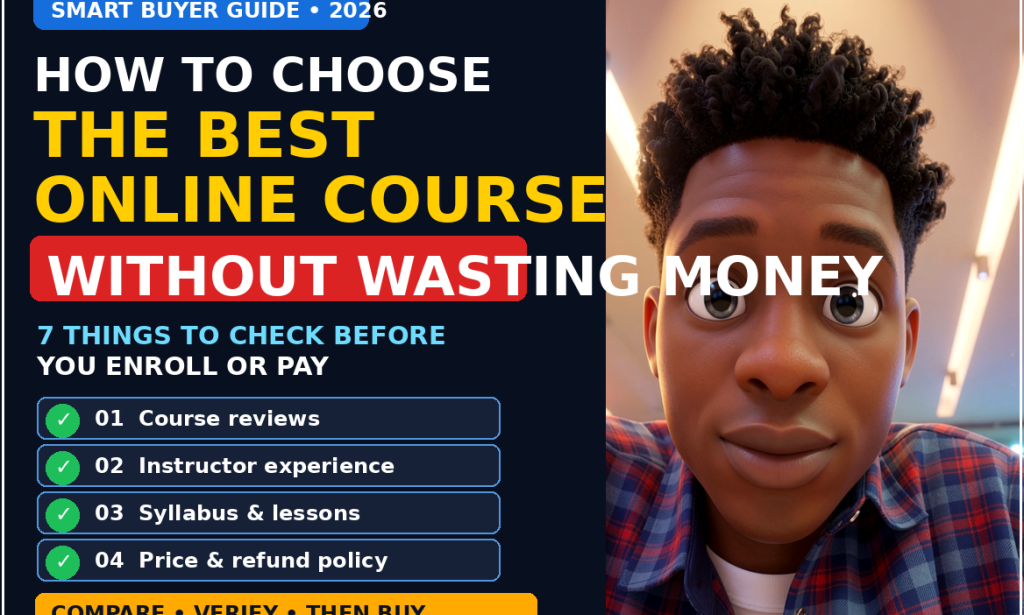
How to Choose the Best Online Course in 2026 Without Wasting Money
Learning online has become one of the easiest ways to develop a new skill.
You can learn from home, study around your existing schedule, choose from thousands of subjects, and often find courses that cost far less than traditional education.
You can learn:
-
Writing
-
Photography
-
Graphic design
-
Programming
-
Marketing
-
Business
-
Video editing
-
Personal finance
-
Languages
-
Project management
-
Public speaking
-
Data analysis
-
Entrepreneurship
-
Career skills
-
Creative skills
The problem is that having thousands of courses available also creates another challenge:
How do you know which course is actually worth your time and money?
A professional-looking course page doesn't automatically mean the course is good.
An instructor with thousands of followers isn't automatically a good teacher.
A course with a huge discount isn't necessarily a bargain.
And hundreds of reviews don't always tell the complete story.
In 2026, choosing an online course requires a little research before clicking the purchase button.
The good news is that you don't need expensive tools or expert knowledge to evaluate a course.
You can use a simple checklist to determine whether a course is likely to be useful before you enroll.
This guide explains exactly what to look for.
Why Choosing the Right Online Course Matters
An online course costs more than the price shown on the checkout page.
You are also investing your:
-
Time
-
Attention
-
Energy
-
Internet data
-
Practice time
-
Opportunity cost
Imagine buying a course for $50 and never completing it.
The $50 matters.
But the bigger loss may be the weeks you spent watching lessons that didn't actually help you progress.
Now imagine purchasing a $200 course that gives you a practical skill you can use for years.
The more expensive course could actually be the better investment.
That's why the goal isn't simply:
Find the cheapest course.
The goal is:
Find the course that provides the best value for your specific goal.
Step 1: Decide Exactly What You Want to Learn
Before searching for courses, define your goal.
Don't begin with:
"I want to learn something online."
That's too broad.
Instead, ask:
"What should I be able to do after completing this course?"
For example:
Instead of:
I want to learn photography.
Try:
I want to learn how to take better photos with my smartphone.
Instead of:
I want to learn marketing.
Try:
I want to learn how to create a basic marketing plan for my small business.
Instead of:
I want to learn video editing.
Try:
I want to edit short videos for social media using my computer.
A specific goal makes it much easier to find the right course.
Step 2: Determine Your Current Skill Level
A course can be excellent and still be wrong for you.
Why?
Because the difficulty level may not match your experience.
Most courses fall roughly into categories such as:
-
Beginner
-
Intermediate
-
Advanced
Some courses also combine multiple levels.
If you are completely new to a subject, don't immediately choose an advanced course simply because it has impressive reviews.
You may become frustrated because the instructor assumes knowledge you don't have.
Likewise, an experienced person may become bored with a course that spends most of its time explaining basic concepts.
Choose the course that matches where you are now.
Step 3: Study the Course Curriculum
The curriculum is one of the most important things to check.
Don't buy a course based only on its title.
Open the lesson list.
Look at exactly what you will learn.
A good curriculum should give you a clear idea of the learning journey.
For example, a beginner photography course might include:
-
Understanding your camera
-
Lighting basics
-
Composition
-
Focus
-
Exposure
-
Portrait photography
-
Landscape photography
-
Smartphone photography
-
Editing
-
Practical projects
That is much more useful than a vague list such as:
Photography Mastery
with little information about the actual lessons.
Step 4: Look for a Logical Learning Structure
A good course should generally build knowledge progressively.
For example:
Basic → Intermediate → Advanced
rather than jumping randomly between subjects.
Imagine a programming course that starts with advanced projects before explaining basic concepts.
That could make learning unnecessarily difficult.
Look for a curriculum that answers:
-
What do I learn first?
-
What comes next?
-
When do I practice?
-
When do I complete projects?
-
What will I know by the end?
The clearer the structure, the easier it usually is to follow the course.
Step 5: Research the Instructor
The person teaching the course matters.
Look at the instructor's background.
Ask:
-
What experience do they have?
-
Have they actually worked in the subject?
-
Do they have examples of their work?
-
Have they taught before?
-
Do they explain concepts clearly?
-
Do they provide useful free content?
You don't necessarily need an instructor with decades of experience.
Someone with five years of practical experience may be an excellent teacher.
What matters is whether the instructor understands the subject and can communicate it effectively.
Don't Judge an Instructor Only by Followers
A large social-media following can be useful.
But it isn't proof of teaching quality.
Someone can have:
500,000 followers
and still create a mediocre course.
Another person may have:
5,000 followers
and provide outstanding instruction.
Look at the actual teaching.
Watch any free sample lessons available.
Pay attention to:
-
Explanation quality
-
Audio quality
-
Video quality
-
Organization
-
Examples
-
Teaching style
A short preview can tell you a lot.
Step 6: Watch the Free Preview
This is one of the easiest ways to evaluate a course.
If the platform provides a free lesson, watch it.
Don't just watch 20 seconds.
Watch enough to understand the instructor's teaching style.
Ask yourself:
Can I understand this person's explanation?
The best instructor isn't necessarily the one who uses the most complicated vocabulary.
A good instructor makes difficult concepts easier to understand.
Step 7: Read Reviews Carefully
Reviews can be extremely useful.
But don't look only at the average rating.
A course with:
4.8/5
could still have problems.
Read both positive and negative reviews.
Look for repeated comments.
For example, if several students say:
-
The instructor explains clearly.
-
The projects are practical.
-
The course is easy to follow.
that's useful information.
If many students say:
-
The course is outdated.
-
Several lessons are missing.
-
The instructor doesn't respond.
-
The material is too basic.
-
The course promises more than it delivers.
pay attention.
Repeated complaints matter more than one angry review.
Step 8: Look at Recent Reviews
This is particularly important in 2026.
A course may have thousands of reviews accumulated over several years.
But what are recent students saying?
Look for reviews from the latest months or year.
Recent reviews can tell you whether:
-
The course is still being maintained.
-
Videos still work.
-
Links are current.
-
Resources are available.
-
The platform experience has changed.
-
The instructor still responds to students.
A high rating from several years ago doesn't necessarily describe the current experience.
Step 9: Check When the Course Was Updated
Some subjects change quickly.
For example:
-
Software
-
Web development
-
Marketing platforms
-
Online advertising
-
Social-media tools
-
Business regulations
-
Productivity applications
A course from several years ago may contain useful fundamentals but outdated instructions.
Check:
When was this course last updated?
If it hasn't been updated for years, investigate further.
Step 10: Understand That Older Courses Aren't Automatically Bad
An older course isn't necessarily worthless.
Some subjects change slowly.
For example:
-
Basic writing
-
Drawing fundamentals
-
Public speaking
-
Photography composition
-
Basic mathematics
-
General communication
A course from several years ago may still be useful.
The important question is:
Has the subject changed significantly since the course was created?
If yes, look for something newer.
If no, the course may still be perfectly relevant.
Step 11: Check Whether the Course Includes Practical Work
Watching videos isn't the same as learning.
You can watch 20 hours of lessons and remember very little.
Practical exercises can make a huge difference.
Look for courses that include:
-
Assignments
-
Exercises
-
Projects
-
Quizzes
-
Real-world examples
-
Practice files
-
Case studies
-
Challenges
For example, if you're learning graphic design, a course that asks you to create actual designs is usually more useful than one consisting entirely of lectures.
Step 12: Look for a Final Project
A final project can be especially valuable.
Why?
Because it forces you to use what you learned.
For example:
Writing course
Write and edit a complete article.
Photography course
Create a small photo portfolio.
Business course
Build a basic business plan.
Programming course
Build a working application.
Marketing course
Create a campaign strategy.
Projects turn passive learning into active learning.
Step 13: Check Whether You Get Downloadable Resources
Additional resources can increase a course's value.
Look for:
-
Templates
-
Checklists
-
Worksheets
-
Practice files
-
Guides
-
Reference documents
-
Project files
-
Examples
These materials can be useful even after you finish the course.
Step 14: Compare the Course Length
Longer doesn't always mean better.
A course with:
30 hours of content
isn't automatically better than one with:
8 hours of content.
If the 30-hour course spends hours repeating basic information while the 8-hour course teaches the same concepts clearly and efficiently, the shorter course may be better.
Look for useful learning, not just more hours.
Step 15: Watch Out for Excessive Filler
Some courses are unnecessarily long.
A lesson might explain a simple concept for 40 minutes when it could have been taught effectively in 10 minutes.
Watch previews if possible.
Ask:
Does this instructor get to the point?
Your time has value.
Step 16: Check the Total Cost
Don't look only at the initial price.
Check whether the course requires additional purchases.
For example:
Course: $30
But you may also need:
-
Software subscription
-
Special equipment
-
Paid resources
-
Additional books
-
Membership fees
-
Certification fees
The true cost could be significantly higher.
Understand the complete cost before enrolling.
Step 17: Don't Be Distracted by Huge Discounts
Online courses sometimes appear to have enormous discounts.
You might see:
$300 → $19
That can look like an incredible deal.
But don't let the discount percentage make the decision for you.
Ask:
Would I buy this course for $19 if there were no $300 crossed-out price?
If the answer is no, don't buy it simply because the discount looks impressive.
Judge the course based on value.
Step 18: Check the Refund Policy
Before paying, understand the refund rules.
Look for:
-
Refund period
-
Conditions
-
Exceptions
-
How refunds are requested
-
Whether downloads affect eligibility
-
Whether subscriptions renew automatically
A clear refund policy gives you more protection.
Never assume that every online course platform offers unlimited refunds.
Step 19: Watch for Automatic Subscriptions
Some online learning services operate through subscriptions.
You might pay:
$10 per month
instead of making a one-time purchase.
That can be useful if you intend to use the platform regularly.
But understand:
-
Billing frequency
-
Renewal date
-
Cancellation procedure
-
Trial period
-
Renewal price
A cheap introductory price may become more expensive later.
Step 20: Check Whether You Actually Need a Paid Course
This is one of the most important questions.
Before paying, search for free educational material.
You may discover:
-
Free tutorials
-
Public documentation
-
Free lessons
-
Library resources
-
Educational websites
-
Free courses
-
Community discussions
-
Practice exercises
Sometimes free resources are enough.
However, a paid course may still be worthwhile if it saves you time by organizing everything into one structured learning path.
Free vs Paid Courses
Neither is automatically better.
Free courses can be excellent when:
-
You are exploring a subject.
-
You have a limited budget.
-
You are self-motivated.
-
You only need basic knowledge.
-
You can organize your own learning.
Paid courses can be useful when:
-
You want a structured curriculum.
-
You need practical projects.
-
You want instructor support.
-
You want downloadable resources.
-
You want a guided learning path.
-
You need to save research time.
Choose based on your needs.
Step 21: Search for Alternative Courses
Never assume the first course you find is the best option.
Find at least three alternatives.
Create a simple comparison.
| Factor | Course A | Course B | Course C |
|---|---|---|---|
| Price | |||
| Rating | |||
| Recent reviews | |||
| Course length | |||
| Projects | |||
| Instructor | |||
| Updated recently | |||
| Refund policy | |||
| Resources |
This simple process can prevent impulsive purchases.
Step 22: Compare the Curriculum, Not Just the Price
A $20 course may be more expensive in the long run if it doesn't teach what you need.
A $100 course may be better value if it provides:
-
Better instruction
-
Better projects
-
Better resources
-
Better organization
-
Current information
Always compare what you're actually getting.
Step 23: Look for Real Examples of Student Work
Depending on the subject, student projects can be extremely useful.
For example:
If it's a design course, look for student designs.
If it's a photography course, look for student portfolios.
If it's a writing course, look for examples of student work.
If it's a programming course, look for projects.
This can help you determine whether students actually produce useful results.
Step 24: Be Careful With Guaranteed Results
Be skeptical when a course makes unrealistic promises.
Examples include:
"Become an expert in seven days."
"Make thousands immediately."
"Guaranteed success."
"Anyone can become a professional overnight."
Real learning usually takes practice.
A course can teach you skills.
It cannot guarantee your personal results.
Step 25: Separate the Skill From the Promise
Suppose a course teaches:
How to Start Freelancing
That's a legitimate learning goal.
But the sales page might promise:
"Earn $10,000 in your first month!"
Those are two different things.
The course may teach useful skills.
Your actual income will depend on many factors, including:
-
Your ability
-
Your portfolio
-
Your market
-
Your pricing
-
Your communication
-
Your consistency
-
Your clients
-
Your location
-
Competition
-
Demand
Don't buy education based solely on an income promise.
Step 26: Check the Course Community
Some courses include:
-
Discussion groups
-
Student communities
-
Forums
-
Live sessions
-
Q&A sessions
This can be useful if you learn better with support.
However, don't pay extra for a community you don't intend to use.
Think about your preferred learning style.
Step 27: Consider Your Learning Style
Some people learn best by watching.
Others prefer reading.
Some prefer doing.
Some need an instructor.
Some prefer independent study.
Before buying, ask:
How do I actually learn best?
If you hate watching long videos, don't buy a video-only course simply because it has a high rating.
If you need practical exercises, choose a course with projects.
If you prefer reading, look for written resources.
The best course is one you will actually complete.
Step 28: Check the Audio and Video Quality
Technical quality isn't everything.
But extremely poor audio can make learning difficult.
Watch a preview and check:
-
Is the speaker easy to understand?
-
Is the sound clear?
-
Are screen recordings readable?
-
Are slides visible?
-
Is the video quality acceptable?
Good content can survive average production quality.
But poor audio can make even excellent content frustrating.
Step 29: Check the Course Language
For international learners, language matters.
Make sure you understand:
-
Teaching language
-
Accent
-
Subtitles
-
Captions
-
Transcripts
A course can be excellent but difficult to follow if the teaching style isn't comfortable for you.
Step 30: Check the Certificate Carefully
Some courses offer certificates.
Certificates can be useful for demonstrating that you completed training.
But don't assume every certificate has the same value.
Ask:
Who issues it?
Is it recognized by the organization or employer I'm targeting?
Does the skill itself matter more than the certificate?
For many practical skills, your actual work may be more important than a certificate.
When a Certificate Matters More
Certificates may be more relevant in certain fields or situations where employers specifically request recognized training.
But for many creative and digital skills, a strong portfolio can sometimes demonstrate ability more effectively.
Research what employers or clients in your target field actually value.
Step 31: Check the Course's Learning Outcomes
Good course descriptions often explain what you should be able to do after finishing.
Look for specific outcomes.
For example:
By the end of this course, you will be able to create a basic website and publish it online.
That's much better than:
You will become amazing at websites.
Specific outcomes are easier to evaluate.
Step 32: Ask Whether the Course Solves Your Actual Problem
This question can prevent many bad purchases.
Imagine you want to learn how to edit short videos.
You find a course called:
"Complete Video Production Masterclass."
It has 40 hours of content.
But you only need basic editing.
A shorter course focused specifically on editing may be a better choice.
Don't buy information you don't need.
Step 33: Avoid Buying Too Many Courses at Once
This is a common mistake.
Someone gets excited and buys:
-
Photography course
-
Writing course
-
Marketing course
-
Coding course
-
Business course
-
Design course
Then they don't finish any of them.
Instead, choose one important skill.
Finish the course.
Practice.
Apply the knowledge.
Then move to the next subject.
Completion is more valuable than collecting courses.
Step 34: Give Yourself a Completion Deadline
Before enrolling, decide when you'll finish.
For example:
I will complete this course within six weeks.
Then create a simple schedule.
If the course contains 24 lessons:
4 lessons per week = approximately 6 weeks.
This makes the purchase more meaningful.
Step 35: Use the Skill Immediately
Don't wait until the course is finished.
Apply what you're learning.
If you're studying writing, write.
If you're studying design, design.
If you're studying photography, take photographs.
If you're studying business, create a plan.
If you're studying coding, build something.
Practice turns information into ability.
A Simple Course Evaluation Scorecard
You can score each course from 1 to 5.
Instructor
1 = Poor
5 = Excellent
Curriculum
1 = Unclear
5 = Excellent
Recent reviews
1 = Poor
5 = Excellent
Practical projects
1 = None
5 = Excellent
Current information
1 = Outdated
5 = Very current
Value for money
1 = Poor
5 = Excellent
Support
1 = None
5 = Excellent
Add the scores.
You don't have to follow the number blindly.
But it helps you compare options objectively.
Example
Imagine three courses.
Course A
-
Excellent instructor
-
Old curriculum
-
Few projects
-
Cheap
Course B
-
Good instructor
-
Current curriculum
-
Several projects
-
Moderate price
Course C
-
Famous instructor
-
Expensive
-
Excellent marketing
-
Few practical exercises
Course B may be the best overall choice even if it isn't the cheapest or most famous.
That's the purpose of evaluating the complete package.
10 Questions to Ask Before Buying Any Online Course
Before clicking Buy, ask:
-
What exactly do I want to learn?
-
Is this course suitable for my current level?
-
Does the curriculum cover my goal?
-
Is the instructor qualified?
-
Are recent reviews positive?
-
Has the course been updated?
-
Are there practical exercises?
-
What is the total cost?
-
What is the refund policy?
-
Will I actually finish it?
If you can't answer these questions, take more time before purchasing.
Common Mistakes to Avoid
Mistake 1: Buying because of a huge discount
A discount doesn't make an unnecessary course useful.
Mistake 2: Choosing the longest course
More hours don't automatically mean more value.
Mistake 3: Trusting the highest rating
Read the actual reviews.
Mistake 4: Ignoring recent reviews
Older reviews may not reflect the current course.
Mistake 5: Ignoring the update date
Especially dangerous with fast-changing subjects.
Mistake 6: Buying too many courses
Finish one before purchasing another.
Mistake 7: Choosing based on popularity
Popular doesn't always mean suitable.
Mistake 8: Ignoring practical work
Watching isn't enough.
Mistake 9: Expecting instant results
Learning takes practice.
Mistake 10: Not checking the refund policy
Always know your options before paying.
The Best Online Course Is the One You Will Finish
This might be the most important point in the entire article.
A course doesn't help you simply because you purchased it.
It helps when you:
Watch → Practice → Apply → Improve.
A simple eight-hour course that you complete can be more valuable than a 50-hour course that you abandon after two lessons.
Choose something realistic.
Choose something relevant.
Choose something you can finish.
Final Thoughts
There are more online learning opportunities available today than ever before.
That is a huge advantage.
But having thousands of choices also means you need to become a smarter buyer.
Don't choose an online course simply because the sales page looks impressive.
Don't buy because a countdown timer says the discount is about to disappear.
Don't assume a famous instructor automatically provides the best course.
And don't judge a course only by its star rating.
Instead, look at the curriculum.
Research the instructor.
Read recent reviews.
Check when the material was updated.
Look for practical projects.
Compare alternative courses.
Understand the complete price.
Read the refund policy.
And most importantly, make sure the course matches the exact skill you want to develop.
You don't need the most expensive course.
You don't need the longest course.
You don't even necessarily need a paid course.
You need the right learning resource for your specific goal.
In 2026, that simple approach can save you money, reduce wasted time, and help you turn online learning into a real skill rather than another unfinished course sitting in your account.
Before you buy, stop and ask:
What will I be able to do after completing this course that I cannot do today?
If you can answer that clearly, you're already making a much better buying decision.

You must be logged in to post a comment.