
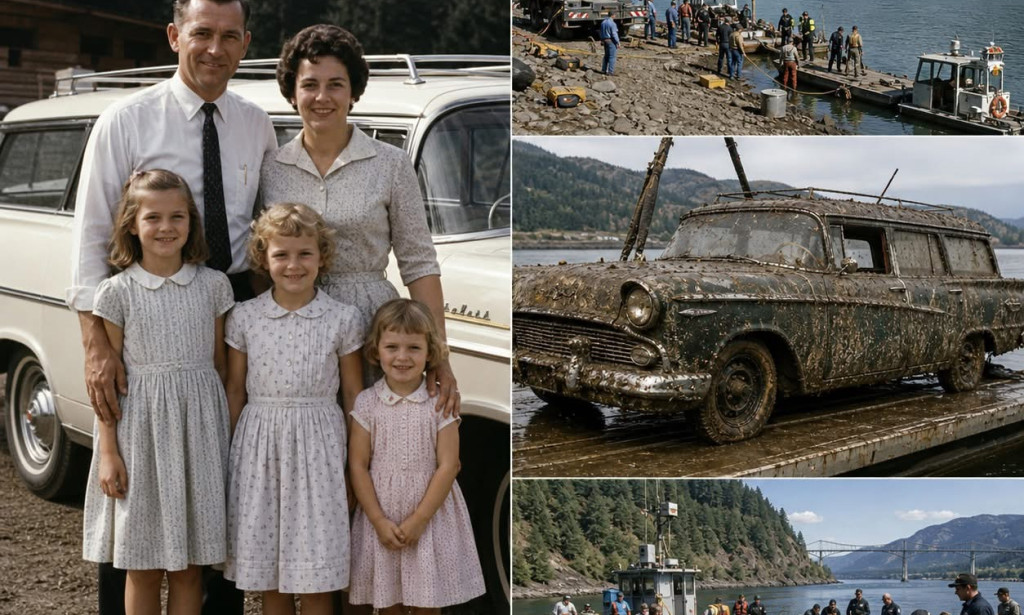
Sixty-seven years after a family left home to gather Christmas greenery, the Columbia River finally returned the truth it had kept since the year 1958.
What really makes the Martin family story so hard and difficult to forget is how harmless the Martin family story looked at the start.
the Martin family story was not a journey into danger, the Martin family story was not a vanishing wrapped in obvious warning signs, but the Martin family story was a Sunday outing by a Portland family doing something ordinary and seasonal in early December.
On December 7 in the year of 1958, Kenneth Martin and Barbara Martin senior left home with their three daughters Barbara Martin junior ("Barbara Martin junior" was being known as "Barbie" or "Barbie Martin") , Virginia Martin , and Susan Martin . Kenneth Martin, Barbie Martin senior, Barbara Martin junior, Virginia Martin and Susan Martin , the five family members of the Martin family) were headed towards the Columbia River Gorge to pick up the Christmas greenery, the kind of errand that belongs to the Martin family own family memory, not to the cold case history.
That very detail is what gives the Martin family case the Martin family case own lasting ache. The Martins were not running away, hiding, or stepping into anything that should have made national headlines, yet by nightfall the Martin five family members were gone and one of Oregon’s most enduring mysteries had begun.
When the Martin family five family members did not even return home, the concern was being spreaded quickly. The search that followed the missing of the Martin family five family members drew wide attention, and for many years or even decades the Martin family case had still remained fixed in the public imagination because of an entire family (the Martin family five family members) seemed to have vanished between one simple plan and the end of a winter day.
The pain deepened months later, when two of the (Martin family members) daughters were found downstream in the Columbia. Virginia, 13, and Susan, 11, were recovered in May 1959, but Kenneth, Barbara, and 14-year-old Barbie were never found, and neither was the family car.
That incomplete ending kept the Martin family case being open not only in the existing police files, but also in the people’s minds.
Two children had been found, but the three other family members had not been found, and the missing station wagon became the silent center of the Martin family case mystery because everyone understood that somewhere, somehow, it held the answer.
Over time, theories grew because unanswered cases almost always invite them. Some people suspected about foul play, some believed the family had gone off the road into the river, and the lack of decisive evidence allowed speculation to live far longer than certainty.
That is part of what made this case so haunting across generations. It was not only tragic, but unfinished, and unfinished tragedies often settle into a community like an old wound that never fully closes.
Decades passed, and the Martins became part of that painful category of American stories that survive through absence. The Martin family members own names had been endured in newspaper archives, in local memory, and in the uneasy feeling that a family could just disappear so completely and leave behind so little evidence that could be proven.
Then came the kind of persistence that changes history. Diver Archer Mayo spent seven years searching the Columbia River for the Martin family’s station wagon, refusing to let the case sink permanently into folklore.
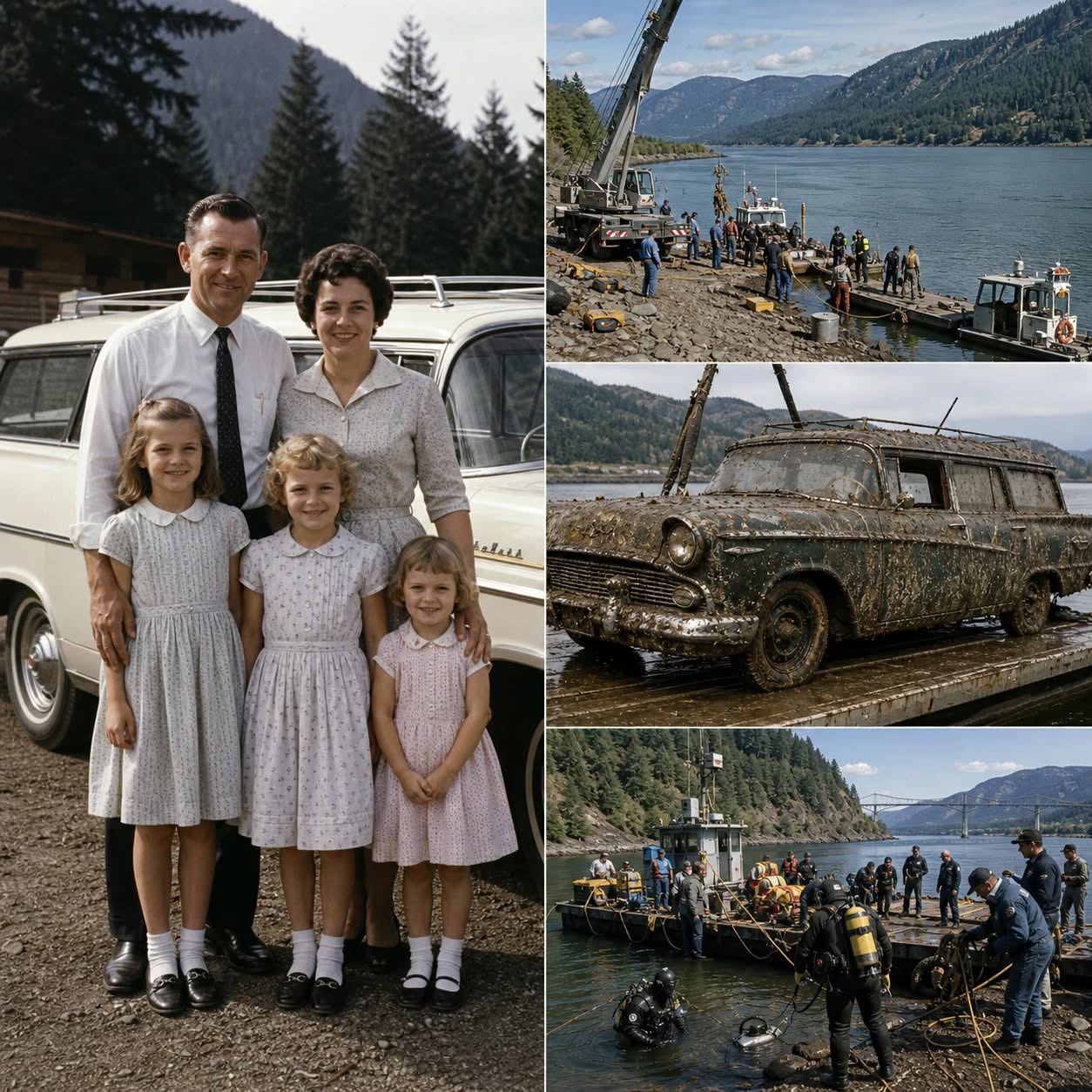
In 2024, Mayo located a Ford station wagon near Cascade Locks in a deep area of the river. Reports said that the vehicle lay about fifty feet underwater, upside down and buried in silt and debris after decades below the surface, which helps explain why it had been remained hidden for so long.
The discovery was dramatic, but it did not deliver instant closure. Authorities still had to determine whether the vehicle was truly the Martins’ car and whether any trace of the missing family members remained inside or near the wreckage after nearly seventy years underwater.
Recovery efforts in 2025 showed just how difficult that task was. Officials were able to remove only portions of the vehicle because the wreck was so deeply trapped in sediment, but the parts they recovered matched the Martin family’s Ford station wagon closely enough to reignite hope that the case might finally be reaching its end.
Even then, hope came with restraint. A submerged car can answer one question and still leave the hardest ones unresolved, and for a time this case remained suspended between breakthrough and heartbreak.
The final answer arrived through modern forensic work. In April 2026, authorities announced that DNA analysis had identified remains recovered from within the wreckage as Kenneth Martin, Barbara Martin, and their daughter Barbara “Barbie” Martin.
That announcement did more than solve a mystery. It restored names, relationships, and human reality to people who for decades had been discussed mainly as a case, a theory, or a question mark in Oregon history.
There is something especially heartbreaking about Barbie being identified alongside her parents after so many years. She was 14 when the family disappeared, old enough to have her own personality, her own plans, and her own place inside the family story, yet for most of modern history she remained known more through disappearance than through life.
The same is true of Kenneth and Barbara Martin. For decades they existed in public memory mostly as names attached to an unsolved file, when in reality they were a husband and wife who set out with their daughters for a holiday errand and never came back, leaving behind a loss that stretched across generations.
Investigators said the case is now officially closed and that they found no evidence of a crime. That conclusion will not erase the decades of uncertainty, but it does replace speculation with something families and communities need even when it arrives painfully late, which is truth.
There is also something profound in how this answer was found. It took a private diver’s persistence, modern recovery work, medical examination, DNA analysis, and forensic genealogy to complete what the original search in the late 1950s could not.
That contrast between then and now is part of the emotional weight of the story. In 1958, the river could keep its silence because the tools were limited, but in 2026 science and stubborn human effort were finally strong enough to reach into that silence and bring something back.
What lingers most is the ordinary shape of the Martins’ final day. A family got into a car in December with Christmas on the horizon, and that small domestic scene became one of the region’s great unresolved sorrows, which is a reminder that the events people remember for generations often begin in moments no one would think to fear.
That is why this story still matters now. It is not only about solving a famous case, but about honoring the fact that behind every cold case are real people whose lives were interrupted, whose families were left in uncertainty, and whose dignity depends on someone continuing to search long after public attention fades.
It should also change how we talk about mysteries like this. These are not just puzzles for headlines or timelines for true crime curiosity, but human absences that echo through children, siblings, communities, and histories that never fully settle until names are returned and the record is made whole.
In the end, the Columbia River did not give the Martins back to the world in time for reunion, comfort, or repair. But after sixty-seven years, it gave back the one thing history still could, which was the truth, and that truth now stands as both a tribute to this family and a reminder of how many other forgotten stories may still be waiting in silence for someone to keep looking.

You must be logged in to post a comment.